
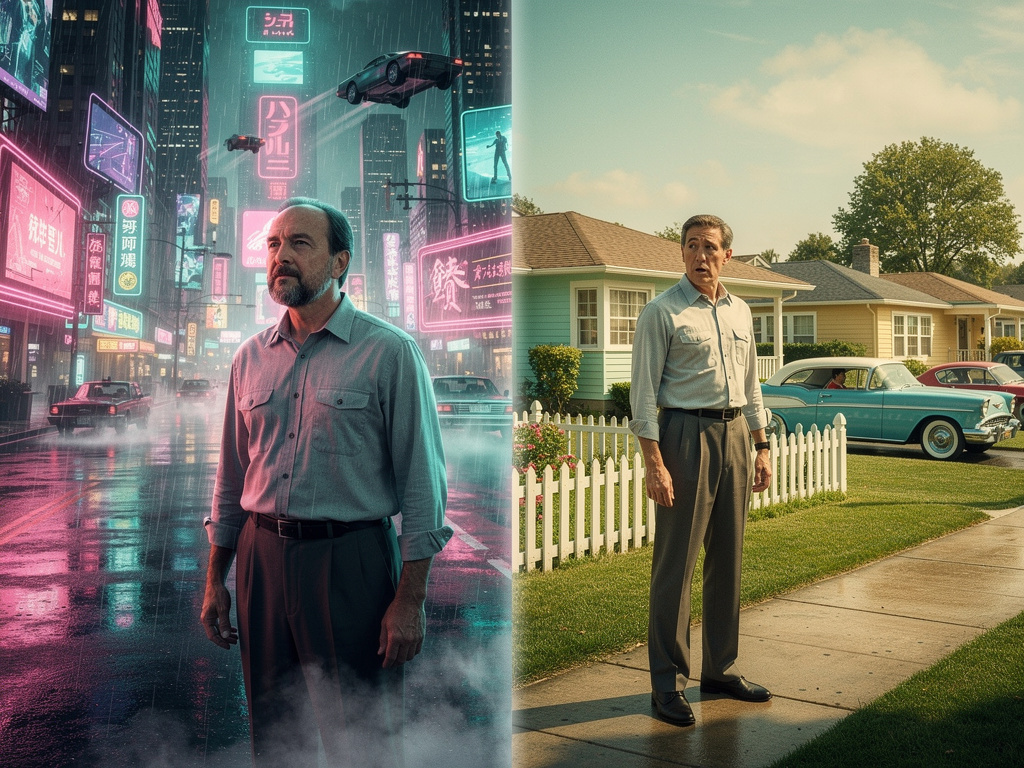
When people talk about the great science fiction writers, the same names usually appear. Arthur C. Clarke imagined humanity reaching the stars. Isaac Asimov explored robotics and vast galactic empires. Frank Herbert gave us ‘Dune’, one of the most influential science fiction novels ever written. And then there’s Philip K. Dick – a writer whose work lingers in the mind long after the last page, not because of its grandeur, but because of its unsettling, relentless question: What is reality?
His stories – ‘Blade Runner’, ‘Minority Report’, ‘Total Recall’, ‘The Man in the High Castle’ – have seeped into popular culture through their adaptations. Yet the man behind them remains elusive, almost as enigmatic as the realities he so often dismantled in his fiction.
What set Dick apart wasn’t just his imagination, but his obsession. He spent nearly his entire career chasing the same question, not as a philosophical exercise, but as a deeply personal inquiry. He genuinely wasn’t convinced that reality was as straightforward as most of us assume.
The Roots Of Doubt
Philip K. Dick was born in Chicago in December 1928, alongside his identical twin sister, Jane. She died just six weeks later. Biographers have long debated how profoundly this loss shaped him. No one can say for certain what a six-week-old baby remembers, but Dick returned to Jane throughout his life. Friends described her absence as something permanently woven into his identity, and readers have noticed the recurring themes of doubles, divided personalities, and incomplete selves threaded through his fiction. Loss became part of the landscape of his life before he was old enough to even remember it.
After his parents divorced, Dick moved with his mother to Berkeley, California – a place where ideas flourished. He loved asking questions that rarely had simple answers. His entry point into these inquiries wasn’t through engineering, physics, or astronomy, but through philosophy.
He encountered the works of David Hume, who argued that ideas like cause and effect might be habits of human perception rather than intrinsic features of reality. Then came Plato’s Allegory of the Cave, which proposes that what we experience through our senses could merely be shadows cast by a deeper, unseen reality. That idea struck Dick with remarkable force.
Decades later, he reflected on Plato’s influence: “Finally, I came to believe that, in a certain sense, the empirical world was not truly real – at least not as real as the archetypal realm beyond it. I despaired of the veracity of sense data. Hence, in novel after novel that I write, I question the reality of the world that the characters’ percept systems report.”
Most people encounter philosophy in university and eventually move on. Dick did not. He carried those ideas with him for the rest of his life, and they became the raw material for his fiction.
Reality As A Lie: The Fiction Of Philip K. Dick
Dick’s work is a labyrinth of ontological uncertainty—his characters (and readers) are constantly forced to ask: What is real? His stories don’t just explore this question; they weaponize it, turning reality itself into a slippery, unstable construct. Here are five of his most potent explorations, each attacking the question from a different angle:
1. ‘Time Out of Joint’ (1959): The Fabricated World
Ragle Gumm lives in a quiet 1959 American town, but small details don’t add up. His neighbors act strangely, objects disappear, and a magazine article about a lunar colony doesn’t match his memories. Slowly, he realizes his entire world is a fabricated illusion – a psychological trap to keep him docile while the real world (1998) grapples with a war.
The cracks in Ragle’s reality – a soda bottle that shouldn’t exist, a bus driver who doesn’t recognize him – mirror the reader’s growing unease. The twist? Ragle is a celebrity in the real world, and his ‘normal’ life is the construct. The title itself suggests that time (and thus reality) is out of joint – broken, unreliable. This novel later inspired The Truman Show, where the protagonist unknowingly lives inside a television show.
2. ‘Do Androids Dream of Electric Sheep?’ (1968): The Nature Of Humanity
In a post-apocalyptic 1992, bounty hunter Rick Deckard retires (kills) rogue androids who’ve escaped to Earth. The androids, nearly indistinguishable from humans, own electric animals, while humans covet real ones. As Deckard’s mission unfolds, he begins to question his own empathy, especially after falling for an android, Rachael Rosen.
The novel dismantles the idea of ‘real’ life: androids mimic humans so perfectly that the only test (the Voight-Kampff) measures empathy – yet humans in this world often lack it. The electric sheep in the title symbolizes the desire for authenticity in a world where even emotions might be artificial. The book asks: If an android believes it’s human, and feels more deeply than some humans, is it less real?
3. ‘The Man in the High Castle’ (1962): Nested Realities
In an alternate 1962 where the Axis powers won World War II, America is divided between Nazi Germany and Imperial Japan. The novel follows characters like Frank Frink (a Jew in hiding) and Juliana Frink, who reads ‘The Grasshopper Lies Heavy’ – a banned book depicting an alternate reality where the Allies did win. The ’I Ching’ (an ancient Chinese divination text) guides decisions, and the novel’s climax involves a confrontation with the titular “man in the high castle” (the author of the alternate-reality book).
Dick uses nested realities to probe authenticity. The characters live in a world that feels real, but the book-within-a-book suggests our reality might be the fiction. The ‘I Ching’ implies that reality is probabilistic – a series of possibilities collapsing into one. The novel’s famous line, “The grasshopper lies heavy”, hints that even the ‘true’ reality might be a construct.
4. ‘The Three Stigmata of Palmer Eldritch’ (1965): Reality As A Drug
In a colonized Mars, settlers endure brutal conditions by using a drug called Chew-Z to enter a shared hallucination. When the powerful Palmer Eldritch returns from a deep-space trip with a new drug, Can-D, users experience a reality so vivid it might be real – complete with a godlike Eldritch who seems to be taking over their minds. The protagonist, Barney Mayerson, resists but is pulled into a nightmare where Eldritch’s reality might be the only one that exists.
Here, Dick weapons reality itself. Chew-Z and Can-D don’t just simulate worlds – they compete with the ‘base’ reality. Eldritch’s drug doesn’t just create illusions; it replaces reality, suggesting that perception is the only measure of the real. The ‘stigmata’ (a mechanical hand, a missing tooth, and a third eye) symbolize the cost of escaping one reality for another.
5. ‘Ubik’ (1969): The Decay Of Reality
In 1992, a group of ‘inertials’ (people with psychic abilities) experience a bizarre decay of reality after an explosion. Objects regress to earlier forms (a cigarette becomes a pre-rolled tobacco leaf), doors vanish, and coins turn into outdated versions. The protagonist, Joe Chip, receives messages from a mysterious spray called Ubik – which may be the only thing keeping reality stable.
The theme: Reality is fluid and consensus-based. Characters argue over whether they’re dead, in a shared hallucination, or trapped in a dying universe. Ubik itself is a MacGuffin that forces the question: Is reality a product we consume, like a can of spray? Or is it a collective delusion? The novel’s ending – where the narrative itself seems to unravel – leaves the reader in the same limbo as the characters.
The Everyman’s Philosopher
More importantly, perhaps, Dick’s work makes abstract ideas concrete. His stories became places where philosophical questions could play out through ordinary people living ordinary lives. His heroes aren’t larger-than-life figures; they’re mechanics, salesmen, police officers, repair people – individuals trying to survive while the rules of reality slowly unravel around them.
As the 1960s arrived, Dick entered what many consider the most remarkable period of his career. The books appeared in rapid succession: ‘The Man in the High Castle’, ‘Martian Time-Slip’, ‘Dr. Bloodmoney’, ‘The Three Stigmata of Palmer Eldritch’, ‘Do Androids Dream of Electric Sheep?’, and, of course, ‘Ubik’.
The questions that fascinated him since his youth drove his work: How do we know the world is real? Can history have alternatives? Can memory be trusted? What separates human beings from convincing machines? And fundamentally, why do people accept the realities presented to them?
Dick believed that the human mind craves novelty above almost everything else. Science fiction satisfied that desire because it allowed writers to invent entirely new worlds while exploring ideas that couldn’t easily be examined anywhere else. He also suggested that science fiction readers tend to excel in abstract thought and possess an abundance of imagination. Whether you agree with that assessment or not, it tells us something important about Dick himself: he wasn’t just entertaining us. He was thinking out loud.
The Enduring Legacy Of Unanswered Questions
Friends often described Dick as warm, funny, and generous, though they also recognized an anxious side that never seemed far beneath the surface. Perhaps that’s one reason he continued asking difficult questions instead of settling into familiar territory. Every new novel became another opportunity to examine reality from a different angle.
His work endures because his readers recognize that his stories aren’t puzzles with tidy solutions. They’re fundamental questions that we all encounter sooner or later: Who am I? Can I trust my own memories? Is the world around me genuine? And what does it actually mean to be human?
Philip K. Dick never claimed to possess the answers. Perhaps that’s why he remains such a fascinating figure. He didn’t just write stories – he invited us, the readers, into the investigation. More than 40 years after his death, we’re still following the trail he left behind.


Leave a Reply