
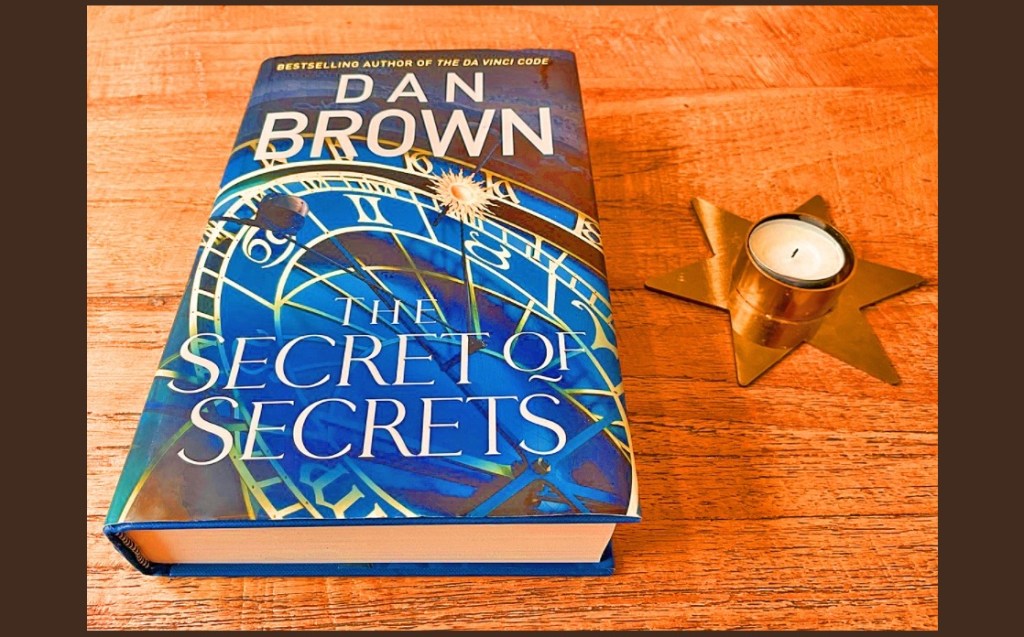
– Contains spoilers to ‘The Secret of Secrets’ –
Is the world headed to a new scientific mindset? I think this might be happening, even though with the current political hellscape in the USA, the Ukraine war still raging, the genocide in Gaza, and countless other atrocities unfolding across the globe, it can feel as if human evolution is running backwards.
Yet online – in discussion forums, academic debates, and emerging intellectual communities – there are signs that the long-standing dominance of materialism may be beginning to fade.
Popular Culture As A Catalyst For Change
Changing the collective ‘mega-mind’ of the public is no small feat; such shifts often take generations. Quantum mechanics brought the mind into the realm of physics as early as the twentieth century, and yet public understanding of consciousness has remained largely unchanged.
What is a huge contributor to a new mindset is popular culture. New ways of thinking can spread virus-like, thanks to books, movies, television series, social media, and now also A.I. The material mindset – that sees the universe as unintelligent, and life and consciousness as having no relation to the physical world – has been largely resistant to change.
For that to change, the biocentric ideas researched on this website have to reach a contagion level, so that they can replicate like a virus. It cannot be predicted when this will happen, but products of popular culture can help to speed up the transition. The latest of such products is a brand new novel by best selling author Dan Brown (‘The Da Vinci Code’). It is called ‘The Secret of Secrets’ and it’s the sixth novel in the Robert Langdon series.
The book opens with the near-death experience of a neuroscientist. She explains to herself in clear terms that what she is experiencing – floating above the city of Prague, massless, and formless – cannot be happening. In the materialist perspective, death is the end and all experience, which is created by chemical compounds held in suspension by electrical charges in our brains, dissolve into nothing. The afterlife is a shared illusion… created to make our actual lives more bearable.
This is the typical materialist mindset. Brown immediately invites the reader to question that assumption.
Nonlocal Consciousness: A Radical Proposal
Langdon arrives in Prague alongside his new romantic partner, Dr. Katherine Solomon, a leading authority in noetic science. Early in the novel, she addresses a packed lecture hall of scientists and boldly claims that the prevailing model of consciousness – created by the brain and confined within the skull – is fundamentally mistaken. She is about to finish a book in which her new theory of consciousness is explained.
According to Solomon, consciousness is not personal, but a universal force of nature that we tab into with our brains. Her theory is not as radical as biocentrism in stating that consciousness is THE fundament of the universe and everything else stems from it, but she sees it rather as a fundamental aspect of the universe – akin to space, time, or energy.
Had Brown (or his character Solomon) looked at modern physics, he had realized that space and time are not fundamental. All the same, Solomon’s theory – which she calls the theory of nonlocal consciousness – directly challenges the materialist dogma. We don’t have individual minds, but are all connected through an all-encompassing mind field.
In Solomon’s words: ‘In the non-local conscious model, your brain does not create consciousness, but rather experiences what already exists around it. Our brains interact with an existing matrix of awareness.’
While Katherine Solomon is hoping that her book will add substantial weight to the ongoing paradigm shift in how humans view consciousness, dark scientific projects are taking place in the underbelly of the city, and the Golem, a mysterious creature, is roaming around who opposes this project. It turns out that a very powerful organisation wants to do everything to prevent Katherine’s book from coming out. Slowly, she starts revealing what she has discovered about the true nature of consciousness to Langdon, and they go on a journey to discover what this conspiracy is all about.
The Science Behind The Theory
Brown doesn’t approach building the case for a mental universe from quantum mechanics, although it is mentioned several times. Nor does he approach it from the theory of evolution like Donald Hoffman. He approaches it from the viewpoint of noetic science.
Noetic science is an interdisciplinary field of study that explores the nature and potential of consciousness, including how thoughts, intentions, and subjective experiences may interact with the physical world. The term comes from the Greek ‘noesis’, meaning inner knowing or direct understanding. Researchers in this area often investigate topics such as intuition, mind–body connections, meditation, perception, and reports of extraordinary human experiences.
The problem of noetic science has always been the difficulty of replicating peer-reviewed experiments. ‘The inability of noetics to replicate certain results has become the battle cry of materialists everywhere – who will rebrand you an overeager charlatan or fraud’, Solomons complains.
Yet, according to the father of American psychology, William James, in order to disprove the assertion that all crows are black, one white crow is sufficient. An entire flock of white crows had now been flushed out by noetic science, by quantum physics, and by the work of an impressive cadre of academics who were vocal advocates for nonlocal consciousness.
Respected minds like Harold Puthoff, Russel Targ, Edwin May, Dean Radin, Brenda Dunne, Robert Morris, Julia Mossbridge, Robert Jahn, and many others have made astounding findings in diverse fields like plasma physics, nonlinear mathematics, and consciousness anthropology, all of which support the notion of nonlocal consciousness.
Experiments That Hint At A Reality-Creating Mind
Despite the field’s limitations, Solomon points to several experiments that Brown notes are real.
One of these real experiments described by Solomon goes like this: a test person is shown a random stream of images in three categories: horrifying violence, tranquil calm, or explicit sexual content. Brain waves of the test persons are monitored and appropriate sections of the brain light up with the appearance of each specific image. According to the graphs, the brain spikes before the computer had shown the image. Even stranger, the brain reacts not only before the image is displayed, but before the computer’s random-number generator has even chosen which image to show!
In conclusion, the brain is not predicting reality, but creating it.
More evidence for Solomon’s theory is sudden savant syndrome, which is the abrupt manifestation of a skill that was previously absent, like speaking Spanish fluently, or mastering a musical instrument perfectly – as if this skill is downloaded in the mind, like in ‘The Matrix’. An impossibility in the materialist universe.
Similarly, epilepsy is mentioned as a source of creativity: Vincent van Gogh, Agatha Christie, Socrates and Fyodor Dostayevsky described their epileptic attacks as opening a doorway to the divine mental state. A brain state similar to psychedelic states, NDE’s (Near Death Experiences), and organisms.
Another argument: the physical brain is way too small for the massive amounts of information it contains, so it must work like cloud computing. The brain tunes in to the information source (nonlocal consciousness) and detracts the awareness of information it needs at that moment.
Symbols, Secrets, And The Chemistry Of Dying
No Robert Langdon novel would be complete without symbolism. Langdon observes that the most widely used religious symbol may not be the cross but the halo – interpreted by Solomon as consciousness streaming into the human head. Langdon, although still skeptical about the theory, acknowledges that this is perfectly in line with spiritual thinking throughout history.
There is a beautiful description of one of the most famous halo’s in the world: the Statue of Liberty in New York. This perfectly symbolizes the American mind – formed by a collection of the world’s cultures. A realization that is currently forgotten by much of the country.

Halfway through the novel, a major discovery by Katherine is unveiled. It involves GABA, the primary inhibitory neurotransmitter in the human brain, acting as a brake on neuronal excitability.
GABA reduces the ability of nerve cells to send or receive chemical messages, inhibiting neuronal activity. It is essential for managing fear and anxiety. Solomons placed a dying man in a brain monitor to see what would happen to his GABA-levels when he died. She discovered that his GABA-levels dropped to zero, which means that all his filters were gone and he would be able to experience all of reality. This is perfectly in line with NDE’s.
In Solomon’s words: ‘It means that during the dying process, our brain’s filters open up, and we become a radio that hears the entire spectrum. Our consciousness witnesses all of reality. That is why people who have near-death experiences describe a feeling of total connection, of all-knowing bliss. The chemistry proves it! What’s more, in the sixty seconds before the patient’s heart stopped, his brain flooded with high-frequency oscillations that included gamma waves. These are associated with intense memory retrieval, and his levels were off the chart (full life recall is another central element to NDE’s).’
Death, Fear, And Humanity’s Possible Future
The Secret of Secrets is revealed to mean that, if Solomon’s theory of nonlocal consciousness is true, then death is not the end. If humanity will adapt this new worldview – brought about by books like this – then it can have a huge effect on humanity’s mental evolution.
Research suggests that fear of death often drives selfishness, environmental neglect, nationalism, racism, religious intolerance, and materialism– tendencies that seem painfully visible in today’s world.
Conversely, those who do not fear death tend to behave more benevolently. They are more cooperative, more accepting of others, and more attentive to the well-being of the planet.
If future generations were to internalize this perspective, the outlook for humanity might suddenly appear far brighter than it does today.
In Solomon’s words: The one universal fear that drives so much of humankind’s behavior… would evaporate. If we can hold on long enough to arrive at that paradigm shift without destroying ourselves or our planet, then our species may well turn a philosophical corner that ushers in an unimaginably peaceful future.’
READ ALSO: From Here To Eternity And Back Again. About Death In Mental Space


 Free-Consciousness
Leave a reply to Dan Brown’s ‘The Secret of Secrets’ Explores a Radical New Paradigm of Consciousness | FRAGMENTEN UIT HET SCHEMERLAND Cancel reply