

‘The fact that an opinion is widely held is no evidence whatever that it is not utterly absurd; indeed in view of the silliness of the majority of mankind, a widespread belief is more likely to be foolish than sensible.’
― Bertrand Russell
Introduction
Now the quote above is probably a bit too harsh on the scientists who believe the brain is the creator of our conscious minds (which means the vast majority of scientists!). The idea doesn’t seem to be that strange. After all, brains appear to really exist and they are most certainly related to our consciousness, thoughts and feelings.
Time also seems to exist in the universe, and so it makes sense to assume that during the evolution of life somewhere along the way consciousness emerged… Of course, recent scientific evidence as discussed on this platform suggests that both these assumptions are false. But you couldn’t tell that by following the mainstream information sources on science. Materialism is still very much the dominant belief system.
What I would like to do in this essay, therefore, is to explain how the current population of scientists – at least in the West – got their brain-based ideas about the mind. Then I will explain why these ideas, despite of all the evidence against them being true, still hold such a strong position in Western culture. And finally I will give my take on the very difficult question: how can we ‘free’ consciousness from the dominating scientific dogma that currently rules our world?

Picture: Pixabay (fernandozhiminaicela)
The First Assumption: The Brain As Creator Of Conscious Experience
Many science books nowadays take the current scientific paradigm as a given and therefore often contain assumptions. The following example is a passage from the Dutch science book for kids called: ‘The Mystery of Nothing and Endless Snot’ by Jan Paul Schutten: ‘Where do your thoughts and feelings come from? From your brain, right? And what is that brain made of? From atoms. So the butterflies in your stomach that you feel when you are in love, the goosebumps you get when you hear beautiful music, the tears you get from bursting with laughter, the brilliant plans you come up with to solve a problem: all those thoughts and emotions arise from a combination of countless extremely small inanimate particles. The same particles that the moon, pebbles, croquette sandwiches and corkscrews are made of. The same particles shot out of an exploded star billions of years ago.’
In other words, Schutten states here without any reservations that consciousness is in fact produced by the brain as if this has been scientifically confirmed. It hasn’t. In fact, neuroscientists have no idea how brains could produce that unique, subjective feeling. Not that I blame Schutten. As a science writer, he depends on scientists as sources to inform him. And scientists, like Lanza, Campbell and Hoffman, who have radically different ideas about consciousness are very rare. I only discovered their views by chance.
Another telling example: on the back cover of the New Scientist book ‘How Your Brain Works’ it reads: ‘You are your brain. Everything that makes you you, and all your experiences of the world, are somehow conjured up by 1,4 kilograms of grey matter inside your skull.’ Again, this isn’t about how the brain and consciousness relate to each other, but how one (consciousness) emerges from the other (the brain) as if it is an undeniable fact that this is what happens, while in fact the materialists provide no mechanism by which this is supposed to happen.
Even AI-tools like ChatGTP seem to be prejudiced towards the materialist perspective. I asked the AI-assistant how the idea of a mental universe (called idealism in philosophy) was supported by science and it gave me some ideas. However, it also added a fat disclaimer to remind me not to take these ideas too seriously: ‘Although these points may provide some support for idealism, we must emphasize that most scientific disciplines are still based on a material or physical perspective on reality. Idealism remains a philosophical concept that falls outside the traditional methods and explanations of science.’

Picture: Fragmenten.blog
How did this assumption emerge?
The Mind-Body Problem, The Disappearance Of Idealism, And The Death Of Dualism
Consciousness is our ability to experience the world. To feel ‘what it is like to’ for example taste a pie, see the color yellow or hear the howling of a wolf. The ancient and thorny philosophical mind-body problem tries to explain the relationship between these conscious experiences and the physical world. The three basic positions one can take are:
The physical approach to the mind-body problem – called physicalism or materialism – has become the most popular approach in the rational West. As the term suggests, physicalism assumes a fundamentally physical (material) world from which the mind emerged. In this way of thinking, the mind is actually nothing more than a side phenomenon. Humans, and other living beings, can easily be regarded as biological robots and mental experiences have appeared during evolution as mainly practical abilities for survival. Even things that feel immaterial, like love, are explainable by evolution. In short, according to the materialists, the Earth used to be populated by zombie creatures, before the brain became aware of itself over time.
Dualism states that there are two substances, body and mind, that interact with each other. It is not entirely clear how exactly they do this. This movement is still very popular, especially in mainstream religions, such as Christianity and Islam. You have your material, perishable body and also your eternal soul, which, if you behave well, may enter heaven after your death. A well-known dualist was the philosopher René Descartes who was actually a materialist, but he could not find a mechanism in the body through which the mind would arise. His most famous quote is: ‘I think, therefore I am’. A statement about the unique phenomenon of subjective experience.
There is a third position in the mind-body debate: idealism. This name refers to ideas and not ideals. According to idealism, any physical object is just a visual phenomenon floating within the mind. According to idealism, we all share one consciousness and we all put on a meat suit (our body is just an avatar) so that we can participate in this spatiotemporal reality. But the entire physical world and everything in it takes place within the mind. In short, only our consciousness is fundamental. The most famous idealist philosophers were Plato, Berkeley and Kant. Idealism is also compatible with many Eastern philosophies, such as Buddhism, Hinduism, Taoism and Non-Dualism.

Picture: Free-Consciousness
At the start of the nineteenth century, idealism was still a position taken by many scientists. Max Planck for example, one of the founding fathers of quantum physics, said: “I regard consciousness as fundamental. I regard matter as derivative from consciousness. We cannot get behind consciousness. Everything that we talk about, everything that we regard as existing, postulates consciousness.”
But according to quantum physicist Amit Goswami, after World War II the power of science shifted from Europe, which is more philosophy-centered, to America, which is more pragmatic and practical-minded. Therefore, the idealist interpretation of quantum physics got lost in favor of the more seemingly practical philosophy of scientific materialism. Nowadays, idealists are very hard to find in both philosophy and science.
As for dualism, the materialist approach has effectively eliminated it from mainstream scientific practice. The attitude towards dualism is tellingly illustrated by the vision of the Danish science writer Lone Frank in her book ‘Mindfield: How Brain Science is Changing Our World’.
Frank believes a revolution is coming, after which we will realize that we are nothing more than a collection of neurons. ‘That’s not because I find that idea strange, on the contrary’, she writes. ‘Whenever that discussion arises, I am a passionate advocate of it. In countless debates I have shouted at a die-hard dualist, ‘the brain is the soul!’ And countless times I have found myself in a heated argument for abandoning the traditional idea that man is divided into biology and something else. Where on earth would that other thing come from? And where is the proof that it even exists? By the time we get to that point, dualists prefer to respond that we can’t live with the idea that we are only chemistry and molecules. To which I always answer: “Of course we can”.’
That’s it. Dualists can’t explain where that ‘mental stuff’ comes from, and so materialists come across as the rationalist thinkers who are willing to accept the inescapable truth about our origin. But in books like ‘Mindfield’, the idealist proposition is not considered or even mentioned.

Before the 1950s, scientific materialism was firmly entrenched only in the disciplines of physics and chemistry – the science of inanimate objects. After the 1950s, it also began to dominate biology (which became chemistry), the health sciences (which became almost mechanical), and eventually psychology (which became cognitive neuroscience).
Text: ‘The Everything Answer Book’ by Amit Goswami
Picture: Psychology Today
Another Major Assumption That Is Ingrained In Our Culture: Time Is Fundamental
Another – perhaps even harder to dispel – misunderstanding about our world is the belief that, if one could travel back in time to an era before humans or any other living beings existed, one would encounter a universe essentially identical to the present one: a vast container of space, like a gigantic aquarium, within which life later emerged. In the perspective promoted on this website of course, time exists only relative to living observers and never outside of them. In the words of Robert Lanza: ‘There is no absolute self-existing matrix in which physical events occur independent of life.’
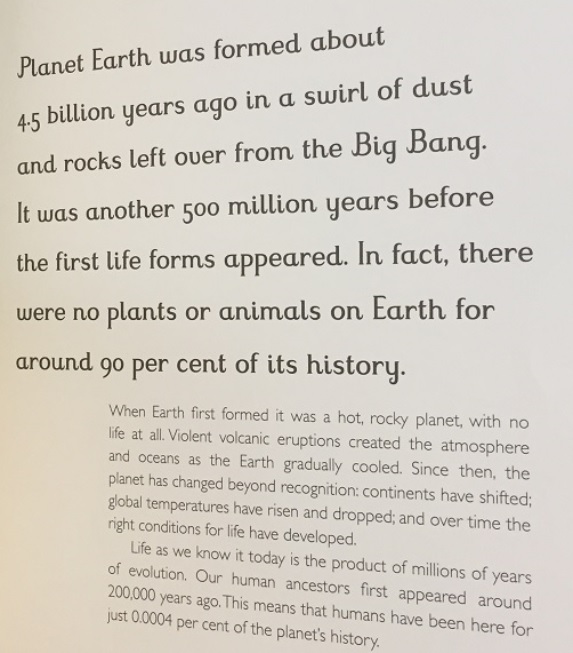
Scientific books contain many assumptions, like taking the linear evolution of the universe as literally true and leaving conscious observation out of the picture completely as a meaningful element.
Picture: Free-Consciousness
As with the assumption that brains create the mind, the assumption that time is real is deeply embedded in popular culture. Consider, for example, the following passage from ‘The Fault in Our Stars’ by John Green: ‘There will come a time when there are no human beings remaining to remember that anyone ever existed or that our species ever did anything. There will be no one left to remember Aristotle or Cleopatra, let alone you. Everything that we did and built and wrote and thought and discovered will be forgotten and all of this will have been for naught. Maybe that time is coming soon and maybe it is millions of years away, but even if we survive the collapse of our sun, we will not survive forever. There was time before organisms experienced consciousness, and there will be time after. And if the inevitability of human oblivion worries you, I encourage you to ignore it. God knows that’s what everyone else does.’
Once again, the assumption is that consciousness emerged somewhere along the way of evolution. But in ‘Biocentrism’, Robert Lanza explains how time, like space, belongs to the living observer. It is an algorithm that weaves together what we observe into logical experiences. The past is created in the present moment retroactively, so that experiences make sense. For example, when a scientist digs up a dinosaur bone, it most likely corresponds to a dinosaur that lived tens or even hundreds of millions of years ago. However, the bone is only there when the scientist is looking at it. The world and all the objects in it, are computed before our eyes. Our mind only computes what is currently under observation and nothing outside of it.

Picture: Pixabay (nnguyen21)
Now, let’s change the dinosaur bone for a small meteor that crashed into earth before life arrived on the scene. Like all rocks from space, its origin can be traced back in principle all the way to the Big Bang. But here the same principle applies as with the dinosaur fossil: only when the archaeologist studies the rock, is it computed. Only this meteor doesn’t correspond to an actual rock flying through space in the absence of any observers, billions of years before life emerged on earth. The past of the meteor is created retroactively in the present moment of the conscious observer. The events are only occurring in the mind, and not in a pre-Earth universe where no observers were present.
But good luck explaining this to the scientific community, let alone the general public.
We simply find it impossible to understand that objective time does not exist. That’s why when we talk about the beginning of the universe, we always end up with a chicken and egg story. ‘God created the universe’, ‘but who created God?’ That is a knot of thought that you can never get out of. The solution – however difficult to imagine – is to consider time as part of your perception. It exists within you and not outside of you.
Your thinking always runs in linear time. ‘First this came, then that happened, and next week I’m going over there’. That’s how your mind works; you cannot think otherwise. However, people who have had a near-death experience have often experienced a different perception of time. Their minds were no longer (completely) connected to the brain and could therefore suddenly contain a lot of information at the same time. And the need to experience everything in order completely disappeared. The perception of linear time was replaced by a holistic view. People could see their entire lives at once and sometimes also understood mathematics, physics and quantum mechanics.
However, when they returned to their bodies, they had great difficulty explaining what they had experienced. The connection between the brain and mind leads to a narrow experience that is very difficult to escape. Hence our need for a clear beginning in time.
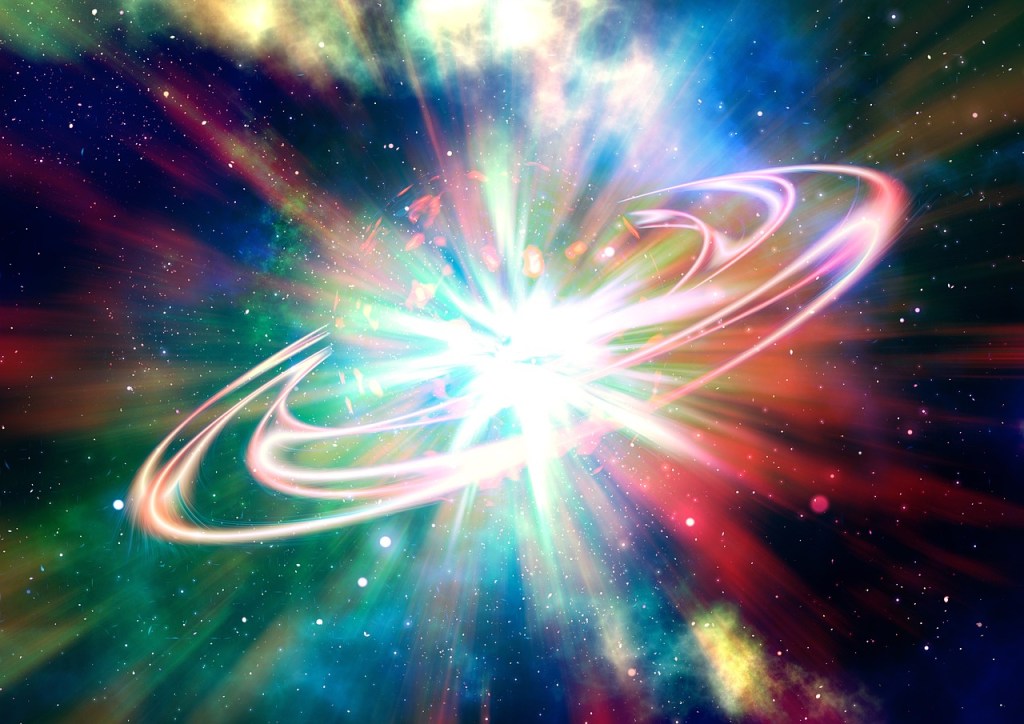
Picture: Pixabay (geralt)
Current View: Consciousness Arose As Evolutionary Advantage
The combination of assumption 1 (the brain creates consciousness) and 2 (time exists outside of the observer) has led to an almost uncrackable baseline for how a large part of the contemporary science community and the general public thinks about our reality. Time is real, life is only a recent phenomenon, and our consciousness has arrived as an advantageous evolutionary trait and plays no role whatsoever in manifesting reality. The assumption that the universe would also be there in the absence of life is accepted as true because it appears to be self-evident.
According to many scientists and philosophers, the mind is nothing more than a product of evolution, arising from the organization of other, non-spiritual ingredients of nature. For example, philosopher Peter Godfrey-Smith writes this about it in his book ‘Metazoa: Animal Minds and the Birth of Consciousness’: ‘Our mind consists of order and activities in matter and energy. This ordering consists of evolutionary products and is developed gradually. Once such an order exists, it is not a cause of the mind, but the mind itself. Brain processes are not the cause of thoughts and experiences, they are thoughts and experiences. In my view, the biological materialist project shows that such a position makes sense and probably reflects how things really are.’[1]
His view is supported by neuroscientist Antonio Damasio who wrote his 2010 book ‘Self Comes to Mind’ from the paradigm that consciousness evolved during evolution. ‘If brains have become dominant in evolution because they offered a greater scope for the regulation of life, then the brain systems that gave rise to the conscious mind have become dominant because they offered the widest possibilities for adaptation and survival for the form of regulation that was able to maintain and increase well-being.’[2]
The goal of the materialist scientists and philosophers has become, in the words of Godfrey-Smith, to better understand why ‘it feels this way to be the material things that we are.’ Of course, if you have been reading some of the stuff on this website, you know that in my opinion we are not material things at all. We are units of consciousness, and our material bodies are merely avatars through which we navigate the spacetime domain. The universe is inherently intelligent, and intelligence is not the result of coincidental processes.
It is getting clear by now that materialism cannot account for the existence of consciousness. Try to explain how a basic mental feature like memory arose. How could a memory possibly be ‘saved’ within a physical brain? Materialist theories will attempt to get closer and closer to the holy grail, but they will never find it.
Scientists and philosophers like Damasio and Godfrey-Smith cannot explain how adding more brain activity, as in more and more neurons firing electrical charge, would all of a sudden create a conscious mind. They have no idea how a brain or other physical system could possibly do this. They simply take it as a matter of faith – faith no different from that felt by a devout Christian or Muslim.
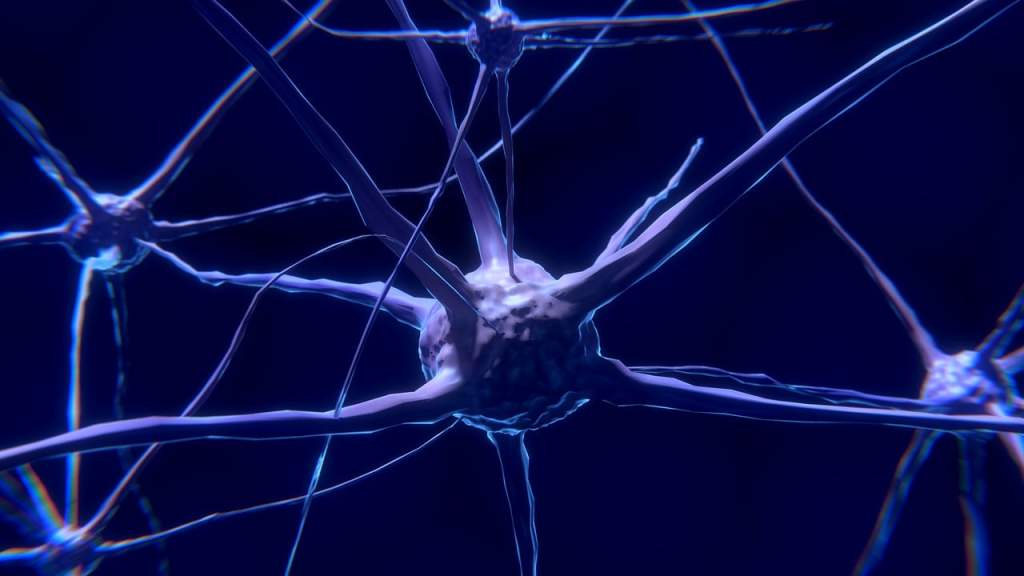
The so-called Hard Problem of Consciousness: Materialists cannot explain why firing neurons should create any experience at all. Of course in biocentrism, there is no Hard Problem of Consciousness because the brain does not create consciousness. It’s the other way around.
Picture: Pixabay (Colin Behrens)
How Science Is Dealing With The Revelations Of Quantum Physics
‘Once the quantum revolution is ingested there is no going back to the classical world, which is recognized to never have existed in the first place.’
— Paul Levy in ‘The Quantum Revelation’
‘From the very start, it was clear that scientific materialism would not stand up to the findings of quantum physics’, writes quantum physicist Amit Goswami in ‘The Everything Answer Book’[3]. ‘Yet we still have not succeeded in resolving the dilemma.’
In physics, more and more clues keep coming in that confirm that ‘spacetime is doomed’. By this, the physicists mean that space and time are not fundamental. These dimensions emerge out of something else. What is that something else? Consciousness is a very good candidate. Why? Because experiments in quantum physics show us that the observer determines what is being observed.
Therefore, according to Fritjof Capra, author of the book ‘The Tao of Physics’, we need a ‘marriage’ of science and mysticism. He writes: ‘The modern physicist experiences the world through an extreme specialization of the rational mind; the mystic through an extreme specialization of the intuitive mind. I see science and mysticism as two complementary manifestations of the human mind; of its rational and intuitive facilities. To paraphrase an old Chinese saying; mystics understand the roots of the Tao but not its branches; scientists understand its branches but not its roots. What we need, therefore, is a dynamic interplay between mystical intuition and scientific analysis.’[4]

Picture: Pixabay (Placidplace)
So far, this has not been achieved in our society, according to Capra. ‘At present, our attitude is too yang – to use Chinese phraseology – too rational, male and aggressive. Scientists themselves are a typical example. Although their theories are leading to a world view which is similar to that of the mystics, it is striking how little this has affected the attitudes of most scientists.’
Capra’s right. Although quantum mechanics makes it pretty clear that consciousness is entangled with the reality it observes on a fundamental level, most physicists don’t accept this. ‘By looking away from the implications of their own theory and what it has triggered within themselves, physicists are, ironically, revealing how a psychological factor has entered into the realm of physics’, writes author Paul Levy in his book ‘The Quantum Revelation’.[5]
‘Most animals, including primates such as humans, show a truly staggering ability to ignore certain kinds of information, particular data which does not fit into their imprinted and conditioned view of the world’, Levy continues. ‘Though potentially brilliant in the realm of science, physicists, as much as any other human, exhibit the same staggering ability to ignore whatever information doesn’t fit the current theory they subscribe to.’
Levy goes so far as to describe the impact of quantum physics on the physics community as a kind of trauma. He calls it: Quantum Physics Induced Trauma (QPIT). According to him, the community’s largely unconscious reactions to its own discoveries display the classic features of a trauma, one that physicists are still in the process of integrating into conscious understanding.
Levy: ‘Confronted with empirical evidence that there is no objective universe existing separate from the act of observation created a previously unimaginable reality crisis in the minds of the most brilliant physicists. Consciousness’ intrusion into their hallowed halls is forcing physics to come to terms with questions of metaphysics, which for most physicists is not what they signed up for. Quantum physics is itself the greatest threat to the underlying metaphysical assumptions of scientific materialism, a perspective which assumes that there is an independently existing, objective material world that is separate from the observer.’[6]

It is not that they are merely disinterested in the appearance of consciousness in their experiments; on the contrary, they have become ‘aggressively/belligerently disinterested’ in the metaphysical implications of their own theory. If we were to view the physics community as if it were an individual, it has an emotional ‘charge’ (analogous to that of a subatomic particle) and is ‘reacting’ (energetically speaking, in an almost violent way) against something in its own discoveries that is being triggered within itself.
Text: Paul Levy in ‘The Quantum Revelation’
Picture: Lesswrong.com
How Will The Shift In Thinking Occur?
Changing the materialist worldview will be an extremely difficult and slow process. I don’t see it happening anytime soon. But when it does happen, who will be the group to first change their views? It has to start with the experts, because they are fundamental in influencing education, literature, journalism, and society’s opinions in general. If most scientists are materialists, then a large part of society will be as well even if only on a subconscious level.
But which group of scientists will be the ones to adopt biocentrism or the mental universe perspective first? I doubt very much that it will be the neuroscientists. They are constantly discovering new correlations between the brain and consciousness, strengthening their belief that they are one and the same thing.
So my money is then still on the physicists to set in motion the Big Paradigm Shift. This will happen very gradually, but the evidence is getting so overwhelming that to keep on ignoring consciousness will become more and more ridiculous. Take this recent headline on MIT Technology Review.com: ‘A quantum experiment suggests there’s no such thing as objective reality’. Certainly there will remain physicists who will keep on trying to explain this from the materialist position, but this is getting more and more unsatisfying.
My guess is that more and more scientists will abandon the materialist path as they come to terms with what may ultimately be the theory best suited to addressing the ‘mysteries’ confronting physics. In addition, experts from other disciplines – such as Robert Lanza and Donald Hoffman – are working hard to publish papers and persuade their colleagues that a paradigm shift is in order. Then there are also the many promoters of the new worldview who are appealing to the general public directly (like this website is trying to do as well). Therefore, I think that gradually the shift will come.

Eventually our mental model of how we view reality will be adjusted to fit all the clues and pieces of evidence that have been found.
Picture: Free-Consciousness
And so, writes Fritjof Capra in ‘The Tao of Physics’, physics might return to its essentially mystical starting point 2,500 years ago.
‘It is interesting to follow the evolution of Western science along its spiral path, starting from the mystical philosophies of the early greeks, rising and unfolding in an impressive development of intellectual thought that increasingly turned away from its mystical origins and develop a worldview which is in sharp contrast to that of the far east (meaning materialism, ed.). In its most recent stages, Western science is finally overcoming this view and coming back to those of the early Greek and the Eastern philosophies. This time, however, it is not only based on intuition, but also on experiments of great precision and sophistication, and on a rigorous and consistent mathematical formalism.’[7]
NOTES
1. Godfrey-Smith, P. Metazoa: Animal Minds and the Birth of Consciousness. Glasgow: William Collins, 2020. P. 28
2. Damasio, A. Self Comes to Mind: Constructing the Conscious Brain. New York: Vintage Books, 2012. P. 77
3. Goswami, A. The Everything Answer Book: How Quantum Science Explains Love, Death, and the Meaning of Life. Newburyport, Massachusetts: Hampton Roads Publishing, 2017. P. 11
4. Capra, F. The Tao of Physics: An Exploration of the Parallels Between Modern Physics and Eastern Mysticism. Boulder, Colorado: Shambhala Publications, 1975. P. 339
5. Levy, P., The Quantum Revelation: A Radical Synthesis of Science and Spirituality. New York: SelectBooks, 2018. P. 184
6. Levy, P., The Quantum Revelation: A Radical Synthesis of Science and Spirituality. New York: SelectBooks, 2018. P. 14
7. Capra, F. The Tao of Physics: An Exploration of the Parallels Between Modern Physics and Eastern Mysticism. Boulder, Colorado: Shambhala Publications, 1975. P. 24


 Free-Consciousness
Leave a reply to Consciousness Is Not Like Gravity: It Is Absolutely Fundamental – Free-Consciousness Cancel reply