

‘The universe is information and we are stationary in it, not three-dimensional and not in space and time. The information fed to us we hypostatize into the phenomenal world.’
― Philip K. Dick in ‘VALIS’
● We are not isolated beings but part of a larger mental structure, with consciousness as the glue binding the universe together. Our experiences and reality are the same thing and the product of mental processes, with everything in constant motion and evolution.
● The mind uses algorithms to construct and navigate reality. These algorithms provide a framework for perceiving and interacting with the world, creating a consistent and logical experience within spacetime.
● Thoughts and feelings are internal processes that significantly shape our reality. Focused thoughts and positive emotions can enhance our experiences and guide us toward better decision-making.
>>> To fully appreciate this essay, it is essential to grasp the distinction between Domain 1 and Domain 2, as outlined in this introduction. In brief: Domain 2 refers to the spacetime realm we inhabit, while Domain 1 represents the origin of pure consciousness from which all things emerge.
What are we? What is our true identity? According to biocentrism or the mental universe theory, we are all like sentient waves of an unimaginably vast ocean, experiencing ourselves as individuals, while in fact we are parts of the whole. Consciousness is the glue that binds the entire universe together.

Picture: Public Domain Pictures
Our source is Domain 1; an immense mental structure that is not located in spacetime. This field is constantly in motion, evolving. Therefore, nothing in our universe is fixed, not even solid objects. There are no things, only processes. And that is what we truly are as well: Mental processes. Or rather: Processing units that translate information into phenomenal experiences.
We are nothing more (or less) than part of an experiencing entity. Our ego-minds result from a gargantuan mental octopus. In our ego-minds several algorithms (sets of rules) create our conception of reality, a conception that comes across as consistent and real.
Go to the park and sit on a bench. Observe all that is around you. There are houses in the distance made of red bricks that seem to radiate. Around you are millions of blades of grass dancing in the wind. The sun – a star 150 million kilometers away – is emitting light that is shining in your eyes. And there is lots, lots more around you to experience.
Your mind weaves all these separate elements seamlessly together into a consistent, seemingly logical experience. An experience that you can comprehend and slowly pick apart piece by piece. Your ego-mind provides you with everything you need in order to survive and thrive. Your mind-software is like a good old-fashioned steam-powered train that computes everything perfectly for you.
We are all part of this continuous programming of experiences. What are the algorithms that your mind uses to construct reality? The list below is very much a simplification, but it gives you a sense of the magic that goes on in this mental information stream that you identify with.
1. Space
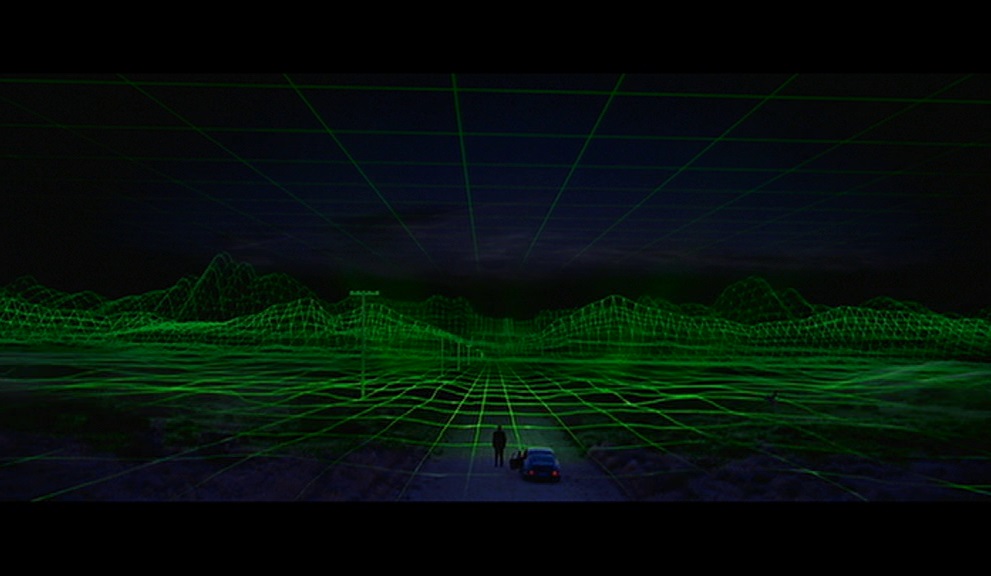
Space is the first algorithm or mind-program in this overview, because it is literally the scene setter. If our mind did not invent space (and time) to have experiences in, the other features of the mind, like objects and even thoughts and emotions, would have no theater to operate in.
All our experiences take place in a mind-program we call ‘space’. Space and the laws of nature that operate inside of it, provide us with a predictable environment. For example, when I pick up my cup of coffee from the table this goes nice and smoothly. The gravity in the room gives me exactly the right handle on the cup so I don’t spoil anything. Nor is the cup too heavy for me to lift. It is perfect for me. 3D space gives us a way to calculate our actions. It is the foundation of our experiences.
Picture: The Thirteenth Floor (1999, Colombia Pictures)
2. Time
Like our minds create space, they are also in the habit of creating time. In our current scientific thinking, we consider time as an external matrix. We assume that we live inside of time. There is a before, a now, and an unknowable future.
However, science is currently reaching the conclusion that time is not fundamental. In the mental universe model that logically follows from that, time is part of the mind. We creatures cannot help but to think in linear time. Even in dreams, when you dream up a certain situation, your mind will often come up with a fake memory of something that preceded it in order to maintain the illusion of a linear timeline. For example, I regularly dreamt that some friend or family member has died while in fact they are very much alive, just to get the continuity right in the dream.
So time, like space, belongs 100% to the experience of the perceiving organism. It is the algorithm by which we observe changes in the information system we call the universe. The past exists only as thoughts in your mind and nowhere else. Like space, time is a necessary part of our conscious experience. Thoughts, feelings and observations require time to take place in.
Our sense of time is closely related to our memory function. The main character in the movie ‘Memento’ suffers from a condition in which he cannot generate new memories (or he makes them, but after a short while he cannot retrieve them). Therefore, time has no meaning for him. There is no before or after for him: he is living in an eternal now. We’re the same, except our memories create the illusion of the flow of time.

Picture: Pixabay (Loaivat)
3. Objects
The things you observe around you are just like thoughts. A difference is that an object is external to you unlike a thought (but not external to your mind!). Also, thoughts flow by while objects remain still and appear to be solid. Telekinesis is not possible in this mindspace we’re in. Once you have created an object in your spacetime vision, its position is locked in. This feature of our mind provides us with consistency and predictability.
An object-subject split takes place between Domains 1 and 2. Biological beings, including trees and plants, are the subjects of nature. They are not only present in nature, but play a key role in dreaming it all together. Objects, such as rocks, chairs and televisions, are just non-biological appearances in this reality-dream that we’re having. These objects exist as thoughts from Domain 1. They do not exist in themselves in Domain 2, but only in relation to living observers. They exist only as experiences. So a hugely important feature of the subjective mind is translating information from Domain 1 into the objects of Domain 2.

Picture: Pixabay (lrcfree)
4. Thoughts
The first three algorithms are ‘external’ creations, which are experienced outside of our head. Now we turn to the internal mechanisms of the mind. Our thoughts are a combination of ideas, pictures, commentaries, memories and narrations that guides our decision making, influences our bodily functions, reflects on the past and comments on current events.
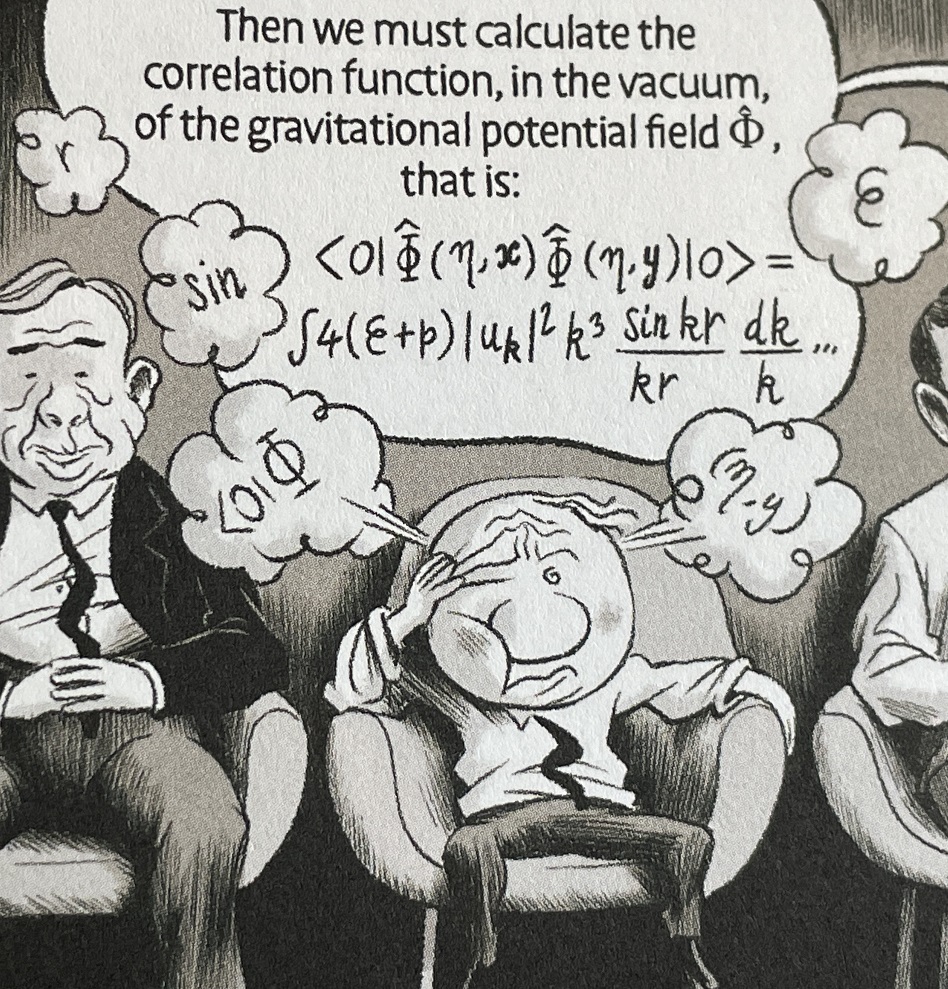
Thoughts come and go, like animals in a forest. They may have no weight and consist of pure refined energy, but still they can be very powerful. ‘Thinking is based on reality only indirectly, but nonetheless it can carry just as much conviction. Nothing is more real than an idea to a person who thinks’, said the legendary psychiatrist Carl Jung.
Therefore thoughts definitely influence our experiences in a big way. A well known truth is: ‘whatever you pay attention to grows’. This very much applies to your world of thoughts. Keep dwelling on negative thoughts and you will create a negative experience. Focus your thoughts on what you find important and you will make it grow and blossom. Our thoughts – and conscious intentions – are therefore a very important tool to shape our reality.
Picture: Mysteries of the Quantum Universe (Mathieu Burniat en Thibault Damour)
5. Feelings
Emotions and feelings are algorithms that guide our behavior. They arise out of Domain 1 and are manifested in Domain 2. This is accompanied by a chemical release in the avatar-body. For example, as soon as your mind creates fear, your amygdala sets off a small chemical bomb consisting of cortisol and adrenaline.
Imagine a mouse hiding from a cat. A prey animal in need, hunted, in agony. The source for the mouse’s mental experience is in Domain 1 and it is translated into a physical experience in Domain 2. Adrenaline rushes through his body: This is fear in physical form. It can be measured in the heart rate and is visible in the brain. That’s biology; the physical translation of the mental state.
Sexuality is a related algorithm in itself that is needed for procreation. We have an elaborate scanning system, always on the lookout to locate the perfect partner. This process takes place for a large part subconsciously, but whenever action is needed, our sexual feelings guide our behavior towards our goals.
Feelings can be difficult, but they are designed to guide our behavior. We want to maximize our joy and minimize our pain. By aiming to feel good, we can generally make healthy choices. But of course, bad experiences like trauma’s can disrupt the programming so that emotions lead to unhealthy choices. When this happens, we have to use our conscious mind to figure out which feelings are fitting in a situation, and which feelings are misleading us to make the wrong choices over and over again. It is a flexible system, and to a certain extent emotions can be reprogrammed.

Picture: Free-Consciousness
6. Being
There is an algorithm that creates the ‘me’ feeling’, the I-center. This gives you the sense of being present in the current moment, a moment in which you can make choices. The universe consists of an almost infinite amount of information, and we are experiencing that bit by bit. This is the well known now feeling. The feeling that we are present somewhere, in our body, and that we are experiencing the present time. We can only experience this mindfully, and when our minds are elsewhere we can always bring it back to this now: The center of our awareness.
Being a self, means the mental integration of all the other algorithms, and the sense of being aware of all the observed phenomena. Being is also about using our senses to experience. The level of awareness can vary wildly. When you are eating for example, it can be in a very conscious and intense way or an almost mindless manner. Being mindful can help us have better experiences and a higher quality of life and decision making in general.

Picture: DeviantArt (Create a game avatar of a great wise by GeniusTechnoMystic)
7. Becoming
According to Thomas Campbell (whom we met in this essay) we are perspectives that can make choices. I am not Jeppe, but a unit of consciousness that makes free will choices for my avatar called Jeppe. We are locked inside a game called ‘Evolution in Spacetime Reality’. It can be fun, it can be cool, it can be tense, it can be terrifying… but the most important thing is to play it well. How? By making the best possible conscious choices for our spacetime avatars. To rack up those fitness points like Don Hoffman says.
You might be experiencing bad things, but there is always room in this game to make good choices. How? Love is the answer. By making choices based on love and not out of fear or ego, we are certain to evolve in the right direction. If we do bad, we might end up evil. And that is something you definitely don’t want because that is the path of suffering (thank you, Yoda). If we base our choices on love, we can still experience bad things, but we can reduce our suffering because love provides us with meaning. Also, by considering this reality as an evolution game every bad thing that happens to us becomes an opportunity to learn and become better.
Making difficult and wise decisions and following them through generally gives us a great feeling. That is because the algorithms are programmed this way. They encourage us to become better by giving us all of these great sensations when we do. They are the rewards we can reap in this ‘Evolution in Spacetime Reality’ game. The biggest rewards are the hardest to get, but they are also the most satisfying.
By making the optimal choices for our avatars, we are also contributing to the evolution of the system itself. The end result is a highly evolved intelligent life form that lives in great balance with itself and nature. We are not there yet, but everybody can contribute. So let’s engage in this multiplayer game and reap the great rewards that are programmed in. So go out there, improve your consciousness and reach your ultimate potential. Total success is guaranteed and the highscore in ‘Evolution in Spacetime Reality’ is for you.
Picture: Free-Consciousness

 Free-Consciousness
Leave a reply to From Here To Eternity And Back Again. About Death In Mental Space – Free-Consciousness Cancel reply