
‘Mind is the matrix of all matter.’
― Max Planck
● The book ‘Biocentrism’ by Robert Lanza and Bob Berman profoundly changed the author’s worldview by proposing that life and consciousness are central to the universe’s creation, challenging the traditional scientific narrative of a randomly evolving universe.
● The authors argue against the randomness of the universe’s formation, pointing out the precise conditions necessary for life, such as specific chemical elements and fundamental forces, suggesting that consciousness plays a crucial role in shaping reality.
● ‘Biocentrism’ posits that consciousness is fundamental, likening the universe to an information system where sentient beings are the processors. This perspective implies that consciousness is not an accidental byproduct but an essential part of existence, providing a sense of immortality and interconnectedness.
In March 2017, I read a science book that completely changed my worldview: ‘Biocentrism: How Life and Consciousness Are Keys To Understanding the True Nature of the Universe’ by Robert Lanza. Books can do that sometimes to a person, but rarely as profoundly as this one did with me. It was a once in a lifetime experience.
With ‘Biocentrism’, which was published in 2009, Lanza (with contributing author Bob Berman) aims to solve the greatest mysteries in science by providing a new Big Picture perspective on the world. The book’s main point is that life and consciousness are not accidental by-products of the universe, but are in fact central to its creation. If you’re intrigued by this as you should be (:-)), a PDF of the book can now be read online for free.

Picture: Free-Consciousness
This new perspective provided by the two trailblazing scientists (Lanza is a biologist and Berman an astronomer) is a radical departure from the story I grew up with. The current narrative, which is still propagated in school books and popular scientific literature today, goes as follows: 13,7 billion years ago, the universe was created by a singular event we refer to as the Big Bang. After that, spacetime started expanding (and still is), the laws of physics appeared and out of gazillion tons of matter, stars and planets started forming.
Fast forward to 3,5 billion years ago. Around a third generation star we call our sun, life emerged. The processes for this are unknown, but are assumed to involve water, chemicals, amino acids and a powerful energy source like volcanism or impact cratering. Subsequently, simple lifeforms evolved into more complex organisms under Darwinian law. The final step happened when creatures with brains and central nervous systems started developing consciousness, which is assumed to be another advantageous trait in evolutionary sense. The thinking goes that being aware of your environment and being able to monitor your bodily functions increases your chances of survival.
To be honest, I went along with this narrative for a large part. I loved science books, like Bill Bryson’s ‘A Short History of Nearly Everything’ which accepts randomness as a major source of creation. I had no major objections against the Big Bang as the start of it all. So where did all the material stuff that emerged come from then? Never thought about it much. Nor did I think it was impossible that ‘happy accidents’ were responsible for the forming of stars and planets or even the beginning of life itself…
My view differed only on how consciousness is generally perceived. I have never accepted the view of the mind as merely some evolutionary after thought. Because of my intuition – and some deep personal experiences – I could never consider the mind as the result of physical processes, but saw it rather as something else. The mind feels eternal to me, but I was still afraid of death for a long time. Because of my new worldview, this fear is now completely gone.
Adios To The ‘Billiard Ball’ Model Of The Universe

Picture: Pixabay (Rudy and Peter Skitterians)
The general idea that randomness is responsible for shaping the physical universe is completely debunked by Lanza and Berman. Think about it: the magic of life explained by stupid bits of matter endlessly bumping into each other.
It is often assumed that because the universe is so incredibly large – with approximately 200 billion trillion stars in it – that the chance that life would appear somewhere is probable. However, this is not supported at all by what science has discovered. There exists a large number of values and other ‘coincidences’ that need to be exactly what they are in order for the existence of life to be possible. This is known as the goldilocks enigma.
For example, all sorts of chemicals are required for life, such as carbon, oxygen, hydrogen, nitrogen, sulfur and phosphorus. Our universe has plenty of them. We also need an abundant energy source like the sun that has a long enough lifespan (10 billion years) for life to evolve. The 4 fundamental forces (gravity, the weak nuclear force, the strong nuclear force and electromagnetism) need to be exactly what they are – not too this or too that – or no life. Also, our 3 dimensions ensure stability and life would not be possible in a universe with a dimensionality other than 3. There are many other bio-friendly features in need of explanation. So it doesn’t matter how huge the universe is, if the values won’t allow for life, there won’t be any.
When someone in a coin toss wins by flipping 20 heads in a row, only a sucker would believe that this person would be playing honestly. The scheme would maybe involve a coin with heads on both sides. The odds of this occurring by chance are really not realistic, so why – when it comes to the unlikeliness of the universe being created by much much much more impossible odds – do we accept it as a reasonable explanation? When was anything created by accident anyway? Don’t worry, the theory of biocentrism does not argue for intelligent design as a solution to this goldilocks mystery. It has a more elegant proposal in store.
Life And Consciousness As Essential Cosmic Attributes
Picture: Pixabay (DanielHannah)
According to the authors of ‘Biocentrism’, the goldilocks mystery can be explained if life and awareness are indeed indispensable cosmic attributes. If conscious observers are needed to turn the universe from an undetermined state into a definite state, they would pick all the right values that would allow for their existence. If we really construct the universe in our minds, it will obviously be a place that suits us really well. And according to the authors, this is exactly the case. Scientific evidence of the last century has shown that you cannot treat animal life as an unnecessary component that might as well not be there.
It appears to us that reality is outside of the observer, but quantum mechanics – which we will look at in more detail in the next essay – shows that the observer seems to play a major role in determining reality at the subatomic and atomic level. The hardcore physicalist will say this is not the case. According to them, there are other solutions to the measurement problem that don’t require living observers. But this opinion might not be unbiased and is in fact contradicted by many quantum experiments.
In the materialist paradigm, there exists an outside world independent of our perception. Our brains create a model in our heads of what this outside world should look like on the basis of sensory information. This picture turns out to be incorrect. We have direct access to what is ‘there’, because we make it ourselves, claim the biocentrists. We are not passive perceivers, but creators. The universe is as mental as the mental ward in ‘One Flew Over the Cuckoo’s Nest’.
When you observe something – for instance, a room – and another person can describe it exactly as you perceive it, it seems reasonable to conclude that the room objectively exists. However, there is another plausible explanation: every conscious observer is connected to a shared source of reality. This source is a mental field (referred to as Domain 1) that exists beyond the boundaries of space and time.
So, does the new paradigm bring humanity back to the center of the universe? Back before Copernicus discovered that the Earth revolved around the sun and was not at all central to the universe? Yes and no. Yes, we turn out to be more than a mere accident of blind evolution. We are an integral part of the information flow that makes up the cosmos. And no, we are still just an unimaginably tiny part of everything there is. The mental field that informs the observable universe is such an immensely powerful cosmic energy field that our little ego minds are completely dwarfed by it. Compare your personal mind to a molecule of a grain of sand lying on a beach. A liter of sand consists of 30,000 trillion trillion molecules, so some modesty about our individual role is in order. But hey, we’re on the cosmic team! And not only that, some scientists that propagate this view also propose that we can participate in the decision-making of this conscious entity through our free will intent. So, we’re all cool.
Implications Of The New Worldview
What could it bring humanity to realize that ‘they’ are simply generated by a cosmic consciousness? It does not suddenly solve all our problems. Far from it. But it does provide a different perspective on things that many people worry about, such as death. Many people assume that consciousness is created by the brain and that therefore physical death is the end of their experience. With the emergence of the mental universe theory, this assumption itself dies an eternal death.
Your brain, although a beautiful, complex organ, does not generate your consciousness. The brain is an object that exists in your mind and not the other way around. A well-known analogy is to confuse the television set with the signal. If you turn off the TV, there is no more broadcast from your perspective. From the perspective of the signal, that is not the case at all. It is true that one localization is now missing that was there before, but the signal continues to broadcast in other places, both local and non-local.

Picture: Pixabay (AlexAntropov86)
The most profound realization I had from ‘Biocentrism’ was understanding that I am not my body but my consciousness. And even more startling – it’s not even my consciousness in a personal sense, but a fragment of a greater mind that encompasses the entire cosmos. Holy shit! No wonder it hit me so hard. Talk about an identity crisis. What I’ve always thought of as ‘me, myself, and I’ is merely one of countless physical avatars through which this universal consciousness expresses itself. In following essays, I’ll delve into questions of purpose and explore why this larger consciousness engages in such an intricate play. For now, I simply want to share the shock and wonder of realizing that I am, quite literally, part of something infinitely greater.
Wrap Up
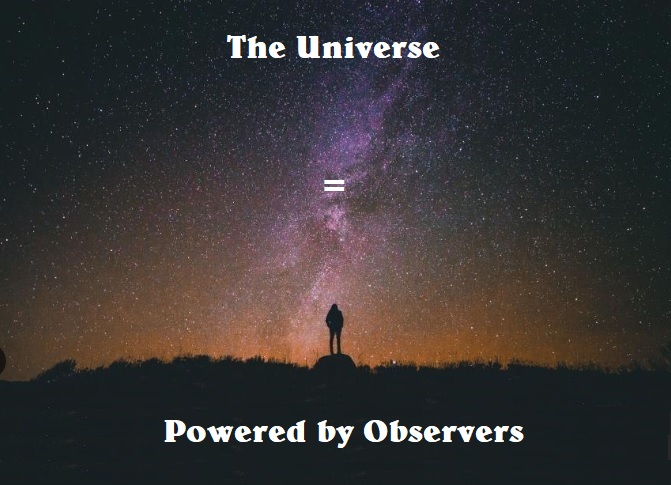
The universe is different than we think. We imagine it as a large container full of space in which objects float around. That is how we experience it. But it is actually an information system. And we – sentient beings – are the information processing units within this system. The conscious observer is indispensable in the existence of this thing called the universe.
Picture: Free-Consciousness
When you are born, you become part of this observerworld. You are then a conscious agent who plays a part in the game that we call reality. Biology provides our consciousness with avatars to navigate through this reality. These bodies have limitations, yet they are very impressive vehicles. And when our avatars die, we return to the source of pure consciousness. This will most likely be a blessing. What I like most about biocentrism are two things. The first is that within this view on reality, every living being is truly equal. Secondly, it means that we are immortal, forever existing as part of an almost infinite being. What an exhilarating thought.
We will now turn to a field of science that teaches us a lot about this mental universe stuff, which is quantum mechanics.


 Free-Consciousness
Leave a reply to Bezwaren tegen nondualiteit | FRAGMENTEN UIT HET SCHEMERLAND Cancel reply