

When discussing the ideas of this website – whether live or online – they will often raise serious questions and objections. This is only logical. Biocentrism goes very much against the current scientific paradigm of a fixed external universe in which observers play no role of importance. Therefore, I decided to create this section to provide answers to the most common questions. If there are questions missing, please let me know in the comments or email me at jkleijngeld@free-consciousness.com.
01) When I close my eyes, I will bump into that lamppost on the street. So I don’t create reality, it is already there…
You’re not just creating reality visually, but through everything you experience. Your consciousness and the reality you experience are one and the same. Everything you experience right now are whirlwinds of information that your mind weaves into a coherent experience. That doesn’t just include your senses, but space and time as well.
Some animals, like moles, are nearly blind and also experience their own reality, but it will be quite different from ours. Every species has a unique design, or a dashboard interface as Donald Hoffman would describe it, that equips them best for reaping the most fitness points. We are not experiencing reality as it is, but as how evolution has shaped it for us.
02) If there is no outside world, how come we all seem to experience the same reality?
Because there must be a shared source of reality: Domain 1. A mind field existing outside of time and space which is the source of both our consciousness and the physical world.
It can be regarded as an eternal information field, consisting of frequencies of inference patterns, which continuously informs the everyday world of appearances.
Read also: First Seeds (2): Two Domains Of Reality
03) If a brain is damaged beyond repair, consciousness ends. So the brain must be responsible for the creation of consciousness.
This is the basic assumption of materialism: the belief that everything that exists is made up of physical matter, and all phenomena, including mental and consciousness-related aspects, can be explained by material interactions and processes. This is a philosophical standpoint that is often confused for objective science. It is not science, because you can never prove that anything exists outside your conscious awareness. You can say that brains exist, but maybe they don’t. Maybe only our observations of brains exist.
And this is precisely the central claim of biocentrism: we falsely believe that the world and what we experience are two different things, but they are one and the same. Everything we experience, including our bodies and brains, are computed in real time by our minds. This view is supported by the latest findings in physics that tell us that space, time and the objects in it are not fundamental. So if brains are not fundamental, how can they create our consciousness which is fundamental?

Picture: Pexels.com (Anna Shvets)
Of course the brain and mind are correlated. Neuroscientists can therefore observe consciousness in the brain and manipulate it. Within this spacetime domain, the brain acts as a filter mechanism, localizing consciousness to the here and now. That is the reason why reducing brain-function (by for example psychedelics, hyperventilation practices, strangulation, holotropic breathwork, certain forms of meditation or brain trauma) can lead to similar transcendental experiences.
04) Since the universe existed long before any living observers, this theory is nonsense.
This is only true if time exists independent from the observer, which is not the case. Since Albert Einstein’s theory of special relativity, the notion of an observer-independent time has already been deeply questioned, and developments in quantum mechanics have placed the idea of objectively existing time under even greater strain.
So who arrived first, living observers or the physical world? This is indeed a strange loop, but was explained by the legendary physicist John Wheeler as a self-excited circuit. The universe existed completely in superposition, until observers arrived and started collapsing possibilities into realities. What we do in the present therefore, affects what happened in the past – in principle all the way back to the origins of the universe. According to Wheeler, the universe cannot really exist in any physical sense – even in the past – until we observe it. Huge parts of the universe must therefore still only exist as probability clouds. As soon as we start observing these parts, the past is created as well as the present.
‘No phenomenon is a real phenomenon until it is an observed phenomenon.’
― John Wheeler
So when you talk about something that has been around for millions of years, there is no absolute truth to that, but only a relative truth. The object hasn’t been sitting around locally for millions of years waiting for the observer to arrive, the observer creates the object (I’m talking about all objects, including planets, our bodies, everything) in his or her consciousness which is part of the all encompassing consciousness of Domain 1. For the observer, the object appears to have been there for millions of years, but time and space are 100% relative. The delayed choice experiment in quantum mechanics supports this view very nicely.
It’s like the chicken and the egg. None of the two can have arrived first, so they must be emerging together in a continuous feedback loop of observation and information processing.
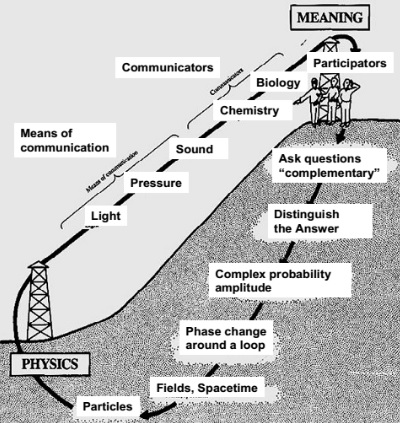
The closed loop of existence: a participatory universe
Wheeler’s ‘meaning circuit’ depicts physical reality as self-explanatory, or ‘self-synthesizing’. Physics gives rise to objects, organisms and, eventually, communicators of meaningful information about nature. In the return part of the cycle, observer-participants interrogate nature for bits of information (ultimately via quantum mechanics), and thus help to shape physical reality, even in the far past. Observers give rise to physics even as physics gives rise to observers. In this manner, Wheeler seeks to avoid the tower-of-turtles problem by claiming that the physical world and its observer-participants explain each other.
From: ‘The Goldilocks Enigma’ (Paul Davies, P. 287)
05) Consciousness has nothing to do with quantum mechanics. Any macro-object can collapse the wave function. That object does not have to be conscious.
This is a well-known interpretation of quantum physics. That objects interacting somehow cause wave function collapse. But when you look at quantum experiments, this really doesn’t add up.
Take the well-known double slit experiment whereby particles like electrons are shot one by one through a double slit apparatus. The result on the other end will always be an interference pattern. Then you install a detector and you switch it on. The result will immediately change to the double stripes of particle hits. Turn the detector off again, and the pattern changes to an interference pattern. If interaction is enough to collapse the wave function, then why don’t the detector or the double slit plate – both macro objects – cause collapse?
The bottomline of these experiments is that knowledge is always key. Particles can behave as seemingly solid bits of matter or ghost-like waves, and only the observer determines which one of these outcomes it will be. If the researcher knows nothing about which way particles will travel, ‘they’ will always behave as probability waves. But if the researcher acquires which-way information, the outcome will always be solid particles.
Conclusion, there are no solid particles out there. When discussing quantum mechanics, we are talking about observations and not about actual things. A particle is just a way to describe an object at one point in spacetime. And the wave is the potentiality of an object that is not yet manifested. All objects are merely descriptions of what we observe. The material world is completely intertwined with our conscious awareness of it.
06) What evidence is there for eliminating the external world anyway?
That question can easily be turned around. What evidence is there for the existence of an external world outside the mind? Everything you observe, you observe through consciousness and there is no way to test whether there are two worlds, one ‘out there’ and a reconstruction of it in your brain.
The only tests that exist for this are at the subatomic level (quantum mechanics) and the results strongly suggest that atoms do not have any fixed properties outside of observation by conscious beings. Based on Ockham’s Razor, biocentrism (the world is formed and fine-tuned within the mind) is the best default view, because you do not make any assumptions. With materialism, you make the assumption that the external world also exists outside of consciousness.
07) What is the relationship between consciousness and the brain?
The brain and consciousness exist in different realms of reality. Consciousness exists in the fundamental Domain 1. A brain is a localized manifestation of this primal consciousness in Domain 2 or spacetime. The brain does not produce consciousness, but transmits it and displays it.
Consciousness is subjective. The brain, like any other object, is objective. It is experienced by consciousness just like tables and chairs are experienced. The brain is the organ that is responsible for the filtering of conscious experiences of creatures within the spacetime domain.
When the brain functions well, the spacetime domain can be explored in a functional way. If the brain is damaged or somehow doesn’t function like it should, the experience of the animal is altered and often not in a good way. So brains and conscious minds are definitely correlated, but they have no causal relationship.
08) How can the universe just start from nothing?
The universe didn’t start from nothing because there is no universe. According to modern physics, spacetime and the objects in it are not fundamental. So you cannot really consider it as a place in which over time things have taken place because that is not what is going on. The universe is not a thing, but a process. Its history is created in every present moment.
09) Is it true that a physicist would rather blow his colleague than admit that cosmic consciousness plays a central role in quantum mechanics?
Yes.
 Free-Consciousness