
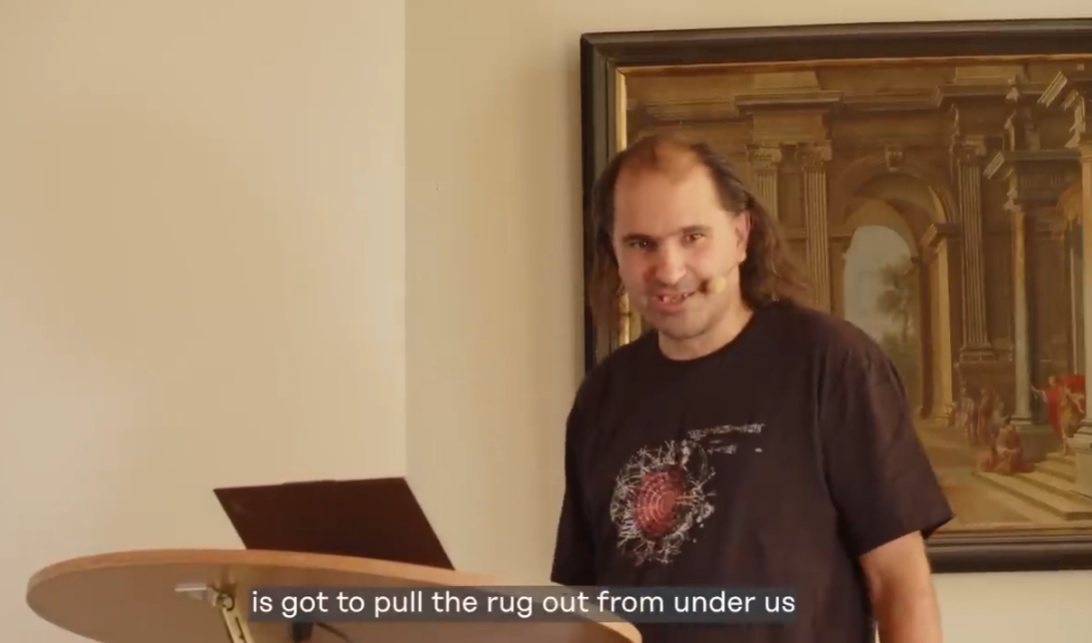
In a 2022 talk at the Max Planck Institute of Physics, theoretical physicist Nima Arkani-Hamed spoke about what he provocatively calls the end of space-time. “We’re in this once in a century moment of theoretical physics where the fundamental principles are shaken up”, he argues.
He’s not alone in this view. Nobel Prize–winning physicist David Gross famously wrote that ‘spacetime is dead’ in a paper published in 2005, exactly one hundred years after Einstein introduced general relativity and launched the modern era of physics.
For the past century, general relativity and quantum mechanics have formed the absolute foundation of our understanding of nature. Together, they explain an astonishing range of phenomena with extreme precision. And yet, Arkani-Hamed argues that they are not the final word. The next phase of physics may pull the rug out from under both of them.
The reason is not that these theories are wrong, but that they may be emergent: powerful approximations of something more fundamental. In particular, the combination of gravity and quantum mechanics strongly suggests that spacetime itself is not fundamental, but an approximate, emergent structure.
Thought Experiment: Why Spacetime May Not Be Fundamental
The argument for the ‘death of spacetime’ is often illustrated by a thought experiment that combines quantum mechanics with general relativity.
Suppose we want to measure smaller and smaller distances in space. To do this, we need light with shorter and shorter wavelengths. Quantum mechanics tells us that shorter wavelengths correspond to higher energies.
As the energy used to probe a region of space increases, Einstein’s relation 𝐸=𝑚𝑐2 tells us that this energy also contributes to mass. Concentrating enough energy into a sufficiently small region means concentrating enough mass there as well.
At some point, gravity becomes dominant. The energy density required to probe extremely tiny distances would be so large that the region would collapse into a black hole. Instead of revealing finer details of spacetime, the experiment would destroy the very region we are trying to observe. No information could escape.
This suggests a fundamental limit: below a certain scale, spacetime cannot be operationally measured at all. And if something cannot, even in principle, be measured or probed, in what sense can it be considered fundamental?
The Planck Scale And Operational Meaning
This limit is usually associated with the Planck scale, defined by fundamental constants of nature. The Planck length is about 1.6 × 10⁻³⁵ meters (or roughly 10⁻³³ centimeters). Below this scale, our current physical concepts – space, time, distance, locality – stop making sense in any operational way. This does not mean spacetime literally ‘ends’ there, but that our existing theories cease to apply.
Cognitive psychologist Donald Hoffman puts this idea in striking terms in a 2024 video. He argues that spacetime is a kind of ‘user interface’ – a simplified data structure shaped by evolution, not a window onto ultimate reality. “Spacetime is a cheap headset, a cheap data-structure. This is not the final reality, but a shallow data structure.”
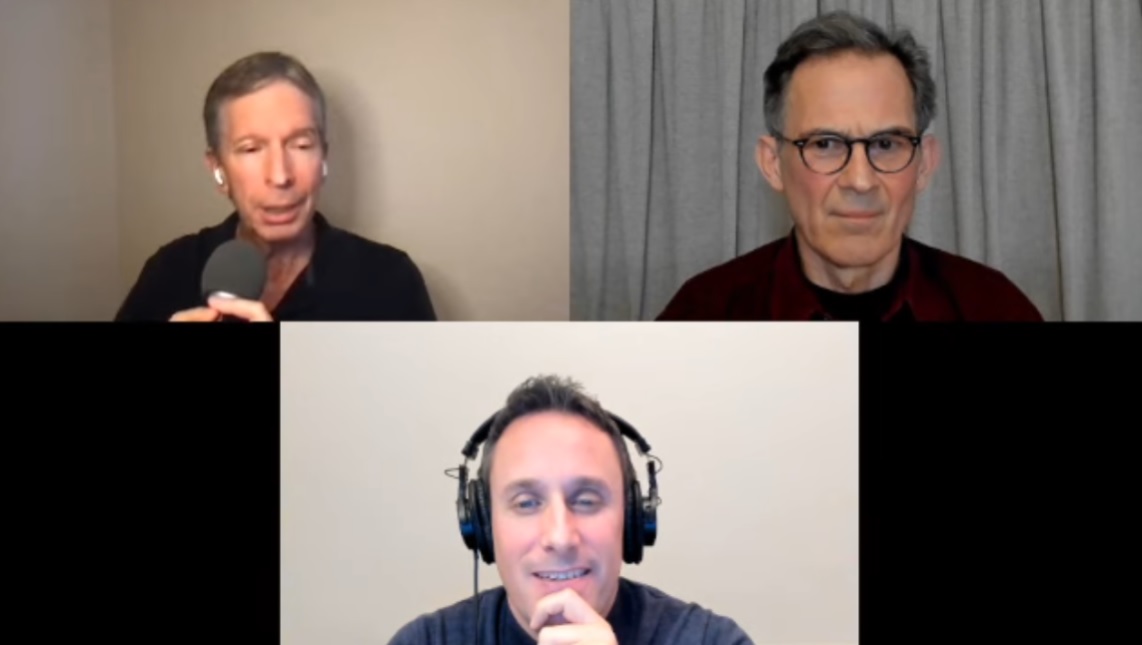
From this perspective, spacetime has no fundamental status; it is merely how reality appears to creatures like us.
Beyond Spacetime And Quantum Mechanics
According to Hoffman, this line of reasoning doesn’t just challenge spacetime, it also challenges quantum mechanics itself. If spacetime is emergent, then quantum theory, which is formulated on spacetime, may also be emergent.
The true ‘holy grail’ of fundamental physics, then, is to discover a deeper structure from which both spacetime and quantum mechanics emerge together, in a way that reproduces all known experimental results.
Most physicists agree on the goal, even if they strongly disagree on the path forward. The mainstream search focuses on mathematical structures such as quantum gravity, holography, and amplitudes. But this is precisely where thinkers like Hoffman depart from the mainstream.
In Hoffman’s theory of conscious realism, spacetime is not the foundation of reality at all; it is the interface of perception. Conscious experience itself is taken as fundamental, and physical objects are secondary, derived structures.
A whole new race is on to discover what reality is made of at its deepest level. My money is on scientists like Hoffman who take consciousness as a starting point and take it from there.


Leave a comment