
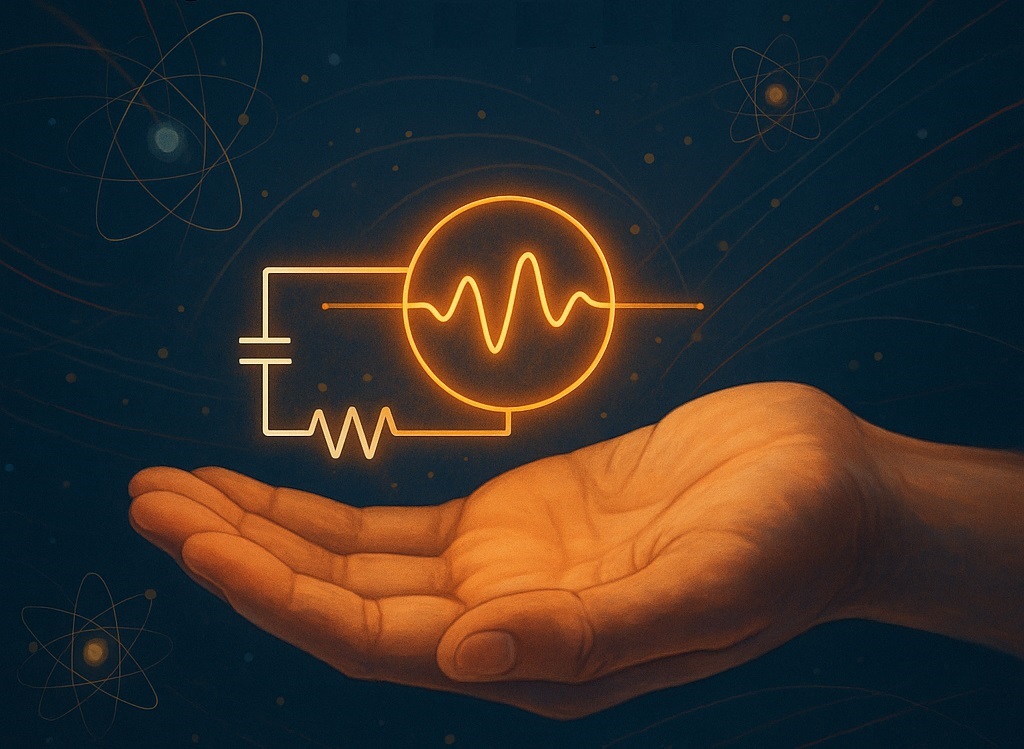
This week, the 2025 Nobel Prize in Physics was awarded to three scientists – John Clarke, Michel Devoret, and John Martinis – for their pioneering experiments demonstrating quantum mechanical effects in a macroscopic system.
Their groundbreaking discovery of quantum tunneling in an electrical circuit has not only laid the foundation for quantum computing, but also challenged long-held assumptions about where the strange laws of quantum mechanics end and the familiar rules of classical physics begin.
The Nobel Committee commended the laureates for proving that “the bizarre properties of the quantum world can be made concrete in a system big enough to be held in the hand.”
Bridging The Quantum And The Classical
For decades, physicists have debated a fundamental question: How large can a system be and still obey quantum laws?
Clarke, Devoret, and Martinis designed an electrical circuit in which they observed both quantized energy levels and quantum tunneling, phenomena previously thought impossible to sustain beyond the microscopic realm.
In quantum mechanics, tunneling allows particles to pass through barriers they seemingly shouldn’t be able to cross. Normally, such effects disappear as systems grow larger and involve countless interacting particles. But these experiments revealed that quantum properties can persist even on a macroscopic scale, a discovery that could reshape how we understand the boundary between the quantum and classical worlds.
Metaphysical Implications
The biocentric interpretation of quantum mechanics – consciousness creates reality – was long rejected because it was thought that quantum mechanical effects wouldn’t apply in the real world. However, this rejection itself was always problematic because it was never made clear at what level the rules of quantum mechanics would no longer apply, and the large-scale rules of general relativity would take over.
Also, it doesn’t really make sense to propose that the universe is governed by two different sets of rules: quantum mechanics for the ultra-small and general relativity for the macroworld—the world of human experience. What makes much more sense is that the universe is entirely quantum mechanical.
After all, it is this theory that deals with the foundation of reality; atoms and subatomic particles are the building blocks of reality. If these turn out to be mental in nature, then this will also apply to the interface of space and time that we take for granted. Indeed, in ‘The Grand Biocentric Design’, Robert Lanza says that ‘the two pillars of physics – quantum mechanics and general relativity – can only be reconciled by taking observers, us, into account.’
Thanks to these Nobel-winning experiments, the notion that quantum behavior can manifest in the observable, human-scale world is no longer philosophical speculation—it’s an experimental fact.
Lanza argues that future experiments with scaled-up superposition could further provide evidence for the mental nature of the universe.
In a recent conversation with ChatGPT, I discussed what type of experiments could be used to once and for all settle this matter.


Leave a comment