

In this series on Worldview Transformation, we’re exploring the ways our current materialist worldview is sustained – through language, assumptions, and cultural habits that reinforce the belief that the universe is purely physical and that spacetime is an objective, external reality.
#3) The Assumption That Life Had A Beginning
From within the materialist worldview, life is assumed to have ‘started’ at some point in Earth’s 4.5-billion-year history. While science has thoroughly demonstrated the reality of evolution and adaptation, the deeper question – how life first appeared – remains one of the greatest open mysteries.
Researchers continue searching for answers. For example, a recent article in Scientific American highlighted a study suggesting that life may have been sparked not just by lightning, as Stanley Miller’s famous 1952 experiment implied, but by ‘microlightning’. This occurs when charged water droplets collide, releasing sparks that can form organic molecules. Unlike rare lightning strikes, this process would have been widespread around waterfalls, waves, and sprays – providing a continuous energy source for prebiotic chemistry.
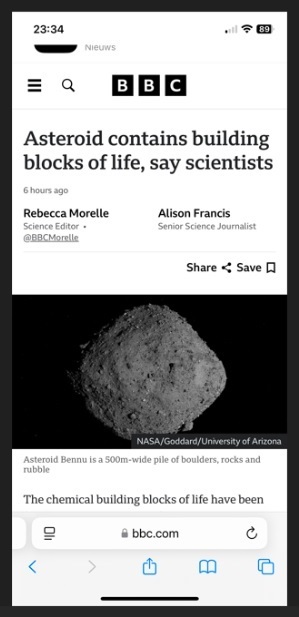
Other hypotheses point elsewhere: perhaps life began near deep-sea hydrothermal vents, or perhaps organic molecules arrived from space. Indeed, NASA scientists recently found amino acids and nucleotide bases on the asteroid Bennu, suggesting that the building blocks of life may quite literally have fallen from the sky.
Yet biocentrism, or the mental universe view, invites us to pause and reconsider whether life really had a beginning at all.
The Biocentrentric View
According to biocentrism, space and time are not external backdrops but properties of the observer. Every event is created in the now, emerging from a sea of possibilities. The past and future are not fixed realities but retroactively constructed as part of present experience.
This means we can trace ourselves back through history: through parents, ancestors, and even the evolutionary tree to a theoretical ‘beginning’. But such a beginning is not a fixed moment in objective time. Where observers are absent, only probabilities exist until they are brought into coherence by consciousness.
Take the Moon’s origin as an example. The prevailing scientific model holds that 4.5 billion years ago, a Mars-sized body called Theia collided with the young Earth, creating debris that coalesced into the Moon. Evidence for this comes from Apollo lunar rocks, which share Earth’s chemistry but also bear the imprint of intense heat.
From a biocentric perspective, this conclusion is not wrong, but the ‘event’ did not occur billions of years ago in some objective past. Instead, it is being created now through observation and interpretation.
The same logic applies to life itself. The ‘beginning of life’ is not a static event lost in the distant past, but part of the ongoing mental algorithm that shapes experience in the present. Life begins where consciousness begins and consciousness, by its very nature, is timeless. It knows no birth and no death. There is only the eternal now.
READ ALSO: Worldview Transformation #2: There Is No Such Thing As ‘After Death’


Leave a comment