

‘All cosmologists and astronomers, regardless of their creed, agree on the puzzling nature of the finetuning of physical forces and constants, so incredibly precise for the origin of life that it cannot be interpreted as mere coincidence.’
― Will van der Bercken, ‘Made From Stardust’
● Many, but by no means all, scientists are atheists or agnostic. They want to explain all of nature’s phenomena without referring to any external influence, such as God or – God forbid – cosmic consciousness. Randomness is currently the mainstream explanation for the many occurrences of fine-tuning found in nature.
● Scientists such as Paul Davies, Robert Lanza and Brian Miller challenge the idea that randomness is the prime driver of the universe because of the extremely precise alignment of natural forces that make life possible, such as the expansion rate of the Big Bang, the 3 spatial dimensions, and the exact values of the 4 fundamental forces necessary for life.
● The mental universe model offers an explanation because if it is the case that reality is created out of gazillion acts of observation. only the physical values are selected that support the life of the observers doing the selecting. Observers must find themselves in a universe, where exactly the right chain of events have occurred that led to their existence.
In the worldview I grew up with, randomness was not just an important factor, but more like the prime driver. The universe, this planet, the emergence of life, and the laws of nature supporting all that, were commonly viewed as ‘happy accidents’.
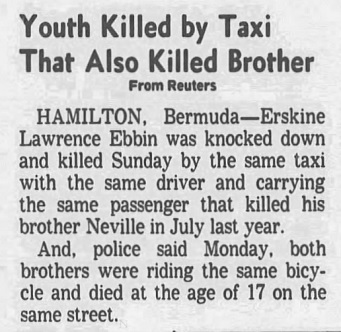
Coincidence is capable of doing some pretty crazy things. Take the famous coincidence story of the Ebbin twin brothers. In July 1975, newspapers on both sides of the Atlantic reported the death of 17-year-old Erskine Lawrence Ebbin. He was hit by a taxi on his moped in Hamilton, Bermuda. The coincidence: his brother had died a year earlier. He was also hit by a taxi on the same street and riding the same moped. He was also 17 years old. And to top it all off, the brothers were both hit by the same taxi carrying the same passenger!
Picture: Newspapers.com
This is a really bizarre story. We can safely say that this must be close to the limit of what randomness can cause. Now imagine a gigantic container of space with trillions and trillions of objects floating around (not that we can think of the universe this way as explained in the previous essays, but just as a thought experiment). What is the probability that collisions between those objects would first create stars capable of nuclear fusion, then planets with exactly the right ingredients for life, then DNA – the most complex structure imaginable, and as icing on the cake, the mind or consciousness emerging out of previously lifeless matter. Oh yes, and just the right ingredients are available for baking your grandmother’s apple pie and burritos with sour cream.
Order, Not Chaos
If randomness was really running the show, you would expect a very messy universe, but that is not what we see. If the universe was created by chance, why is there so little chance around us? A kilometer tall man with a 10 foot cock? A woman with 14 breasts? All natural selection you might say, the laws of nature do not allow for such wild variations. That may be the case, but I imagine a universe that arose out of randomness quite differently. Like a place full of chaos and anarchy and strange anomalies. But on our little planet, everything seems to be beautifully arranged. Have you ever seen something truly bizarre caused by an accident? Not to mention a perfectly functioning world with trillions of individual particles working together harmoniously?
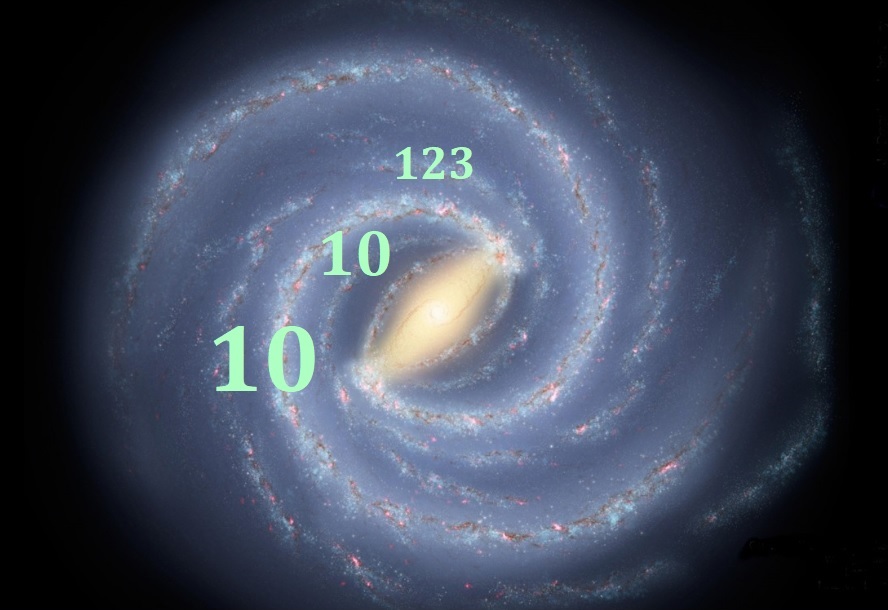
Science did notice this as well. All cosmologists and astronomers, regardless of their beliefs, agree on the mysterious nature of the alignment of physical forces and the incredibly precise constants that make life possible. Mathematician Roger Penrose came up with a static calculation about the chance that a cosmos like ours can arise after the Big Bang. The number he came up with (called Penrose’s number) is: 10^10^123, a number that cannot be written out because it contains trillions of zeros after the decimal point.
Picture: Pxhere / Free-Consciousness
So randomness is not really a reasonable conclusion for the origin of the Goldilocks Universe. But let’s first have a look at some of the features that makes the universe so exquisitely finetuned for the existence of life, and then see if biocentrism or the mental universe model provide an answer for it.
How ‘Goldilocks’ Is The Universe?
‘Instead of finding that space is filled with a dog’s breakfast of unrelated bric-a-brac, astronomers see an orchestrated and coherent unity’, writes the British-Australian and internationally renowned physicist Paul Davies in ‘The Goldilocks Enigma’.(P. 21)
In his book, Davies outlines the numerous features that make the universe exceptionally hospitable to life. Firstly, there is order instead of chaos. Stars and galaxies, even those light-years away, closely resemble those in our Milky Way. The laws of nature are consistent throughout the universe. This order is vital for our existence. Life evolves slowly, which would not be possible in a universe that isn’t stable for billions of years.
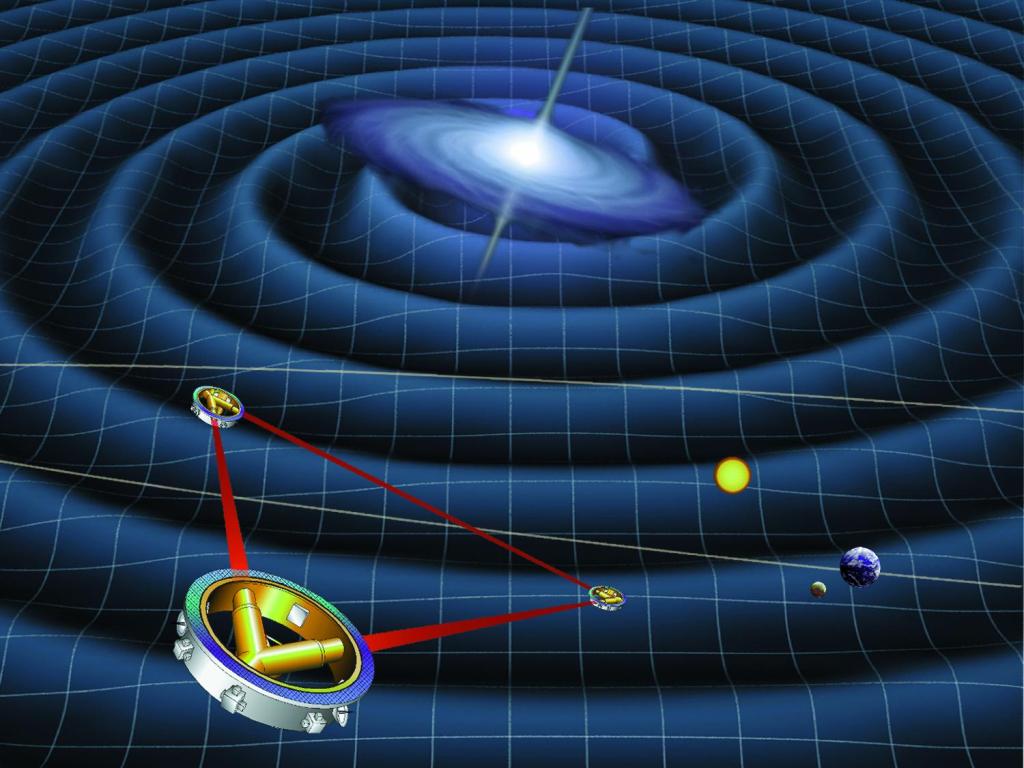
According to science, the universe originated 13.7 billion years ago from a hot, dense, uniform state, then expanded and cooled to its current form. The Big Bang is a life-supporting event. Had the Big Bang’s force been slightly stronger, the universe would have expanded too quickly for atoms to form, and no matter would have been created. If it had been slightly weaker, the universe would have collapsed back on itself. The expansion rate is also conveniently the same in all directions.
Picture: Wikipedia
Davies also explores the crucial role of 3 spatial dimensions for supporting life. It is curious that space could have had any number of dimensions but settled on 3. In the 1950s, English mathematician Gerald Whitrow noted that with 4 dimensions, planetary orbits would be unstable, and Earth would spiral into the sun. With 5 or more dimensions, other problems would arise. Whitrow concluded that life would be impossible with a dimensionality other than 3.
Moreover, the 4 fundamental forces (gravity, electromagnetism, the weak and strong nuclear forces) that govern nature are finely tuned for the emergence of life. If the values of these forces were slightly different, life would not have emerged. Most physicists, following Newton, believe that the gravitational force is consistent across space and time. However, they are unsure why it has its specific value when it could have had any other value if randomness was governing the cosmos.
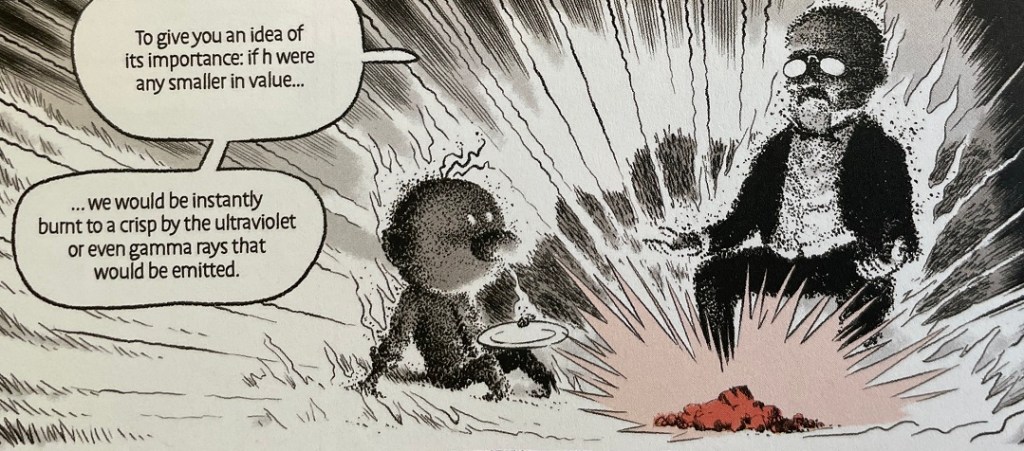
If the strong force were slightly stronger or weaker (by as little as 1%), the binding energies of nuclei would change, disrupting the resonance arithmetic, and the universe might be devoid of life. The weak force, if somewhat stronger or weaker, would alter the universe’s chemical makeup, reducing life’s prospects. If electromagnetism were stronger, the electrical repulsion between protons would increase, threatening atomic nuclei’s stability. These are just a few of the dozens of parameters where slight changes would result in a lifeless universe.
Picture: Mysteries of the Quantum Universe (Mathieu Burniat en Thibault Damour)
Davies questions, if you were the creator of the universe, what could you remove without causing significant damage? Some small stars and large planets might be superfluous. Perhaps some black holes or galaxies could be omitted. At a fundamental level, it would be wise to leave things well alone, he writes. Removing electrons would make chemistry impossible, and abolishing neutrons would mean only hydrogen could exist. This raises the question of why the universe consists of all the things it does consist of.
A Blue Marble Floating In Space And It’s Just Right For Us. Crazy Huh?
Like the universe is perfectly suited for animal life, so is this little planet we call home. In a 2019 article in a European popular science magazine[1], 9 happy accidents are described that ensured that Earth has emerged as the perfect planet for the origin of life. The first one of these lottery winnings is that the Earth’s magnetic field holds the atmosphere and is therefore crucial for the existence of life. The second win is a nearby supernova that occurred 5 billion years ago. If – at the time the Earth was formed – this nearby supernova had not exploded, Earth would have become an ice cube.
A third fortunate coincidence is that our solar system contains two gas giants: Jupiter and Saturn. Had Jupiter been the only gas giant – as appears to be the case in many planetary systems – the rocky inner planets may never have formed at all. In addition, Jupiter plays a crucial protective role. Its immense gravity deflects or captures asteroids and icy bodies that might otherwise collide with Earth, reducing the frequency of catastrophic impacts that could repeatedly wipe out life.
Talking about luck: the distance between the Earth and the Sun is just right. Liquid water is crucial for life on Earth. If the distance to the nearest star is too great, water turns into steam and if the distance is too small, it freezes.

Picture: Free-Consciousness

Picture: Dig and Delve (Delve #3 Brian Miller)
Strike number 6 is a collapse that occurred more than 4500 million years ago. Earth had a collision with the smaller planet Theia, which was about the size of Mars. The iron core of this planet sank into the Earth and the lighter material was ejected into space to form the Moon. Earth therefore has an unusually large core relative to its size, which helps to maintain a magnetic field that protects life from radiation.
The Moon that was created because of this collapse is another crucial element of the life friendliness of this rock we call home. Many planets have moons, but few rock planets have one as huge as our natural satellite. Computer simulations have shown that the Moon stabilizes the direction of the Earth’s axis giving us a very stable climate which we would otherwise not have. We also have plate tectonics to thank for our climate (lucky break Nr. 8). Without it, it might have become as hot here as on Venus, or the atmosphere would have evaporated, just like it did on Mars.
The presence of oxygen is the final miracle. All higher animals need oxygen, and we have it in abundance. On the young Earth, oxygen was chemically bound, but this changed when precursors of blue-green algae developed photosynthesis. For the first billion years, oxygen combined with iron, among other things, but 850 million years ago the oxygen level in the sea and the atmosphere began to rise, paving the way for multicellular life.
According to the publication, the chance that all these 9 lucky accidents would occur is approximately 0,0000000000078125%. We are really quite fortunate indeed.

Picture: Free-Consciousness
The Fine Tuning Of Life Itself
After covering the universe at large and our little planet Earth, we now move to the third and final subchapter of the goldilocks enigma: life itself.
It is clear that life on Earth would have been impossible without a variety of cosmic coincidences, such as the presence of the essential amino acids, the building blocks of proteins, which apparently existed in interstellar dust. For life as we know it we need various chemical elements to create biomass. Carbon is the key life giving element, but oxygen, hydrogen, nitrogen, sulfur and phosphorus are crucial too.
Paul Davies writes this about life: ‘Biological organisms are immensely complex. To a physicist they look nothing short of miraculous. The many and diverse components function together in a coherent and amazingly orchestrated manner. The living cell contains miniscule pumps, levers, motors, rotors, turbines, propellers, scissors and many other instruments familiar from a human workshop.’(P. 218)
In a brilliant video on YouTube, physicist Brian Miller talks about intelligence in nature, and how the dials in a Universe Creation App must be set extremely precisely to get stars, planets and chemistry. Also, life itself has features that cannot be randomly chosen. Take the eye for example. ‘The wavelengths of light are perfect for the optics of the human eye. If wavelengths were longer, the world would become way more blurry’, Miller states.
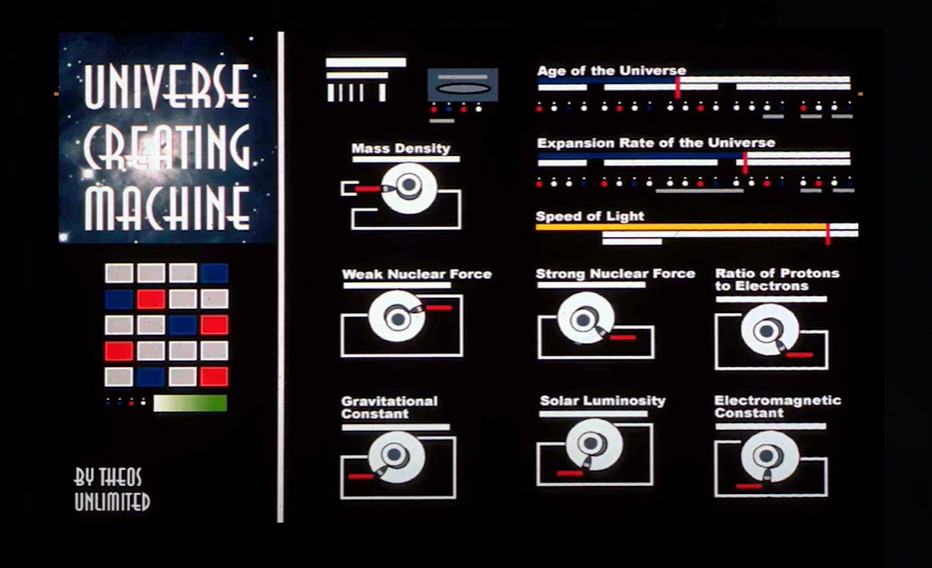
Picture: Dig and Delve (Delve #3 Brian Miller)
His conclusion: an intelligent mind must have monkeyed with physics, as well as with chemistry ánd biology. Robert Lanza agrees: ‘It always strikes me as slightly amazing that any scientist can aver, with a straight face, that they stand there at the lectern – a conscious, functioning organism with trillions of perfectly functioning parts – as the sole result of falling dice. Our least gesture affirms the magic of life’s design.’[2]
Randomness, Still The Current Explanation
We have seen how incredibly unlikely existence is. What is science’s current explanation? In the magazine article I discussed earlier, the editor-in-chief writes in the editorial: ‘According to the American climate agency NOAA, the risk of being struck by lightning in a year is 1:2,000,000. That’s like flipping a coin 20 times and getting heads 20 times. The chance that you will win a Eurojackpot prize of millions is even smaller: the same as throwing heads 26 times. You may think you’d never be so lucky, but you’re even luckier: the odds that the planet you live on isn’t freezing, bombarded by meteors, or sterilized by cosmic rays is about 1:128,000,000,000.’[3]

Picture: Pixabay (jackmac34)
So here randomness is presented as the solution to the goldilocks mystery. In the best philosophical book about randomness ever written, ‘The Black Swan’ by Nassim Nicholas Taleb, the following dialogue is featured:
NNT (The Writer): Suppose I have a coin that is fair, that is, a coin where the chance of heads or tails is the same when you toss it. I toss it ninety-nine times and get heads every time. What are the chances that it will land on tails next time?
Dr. John: Simple question. A half of course, because you assume a fifty percent chance for each roll and each roll stands alone.
Fat Tony: I would say, of course not more than one percent.
NNT: How so? I told you it’s a fair coin, which means there’s a fifty percent chance of both.
Fat Tony: That’s nonsense, or you’re a complete idiot if you believe that about the fifty percent. That coin must have been tampered with. This can’t possibly be fair. (Translation: It’s far more likely that your assumptions about the fairness of the coin are wrong than that ninety-nine tosses will produce ninety-nine heads.)
So using Taleb’s logic, when you think critically about randomness as a cause, it would be wise to abandon this insane explanation completely. It is far more likely that something else is going on. “There are dozens and dozens of these parameters, and aside from saying ‘God did it’, nobody knows why it can be that way, including the physicists. If you tweak one of those values you never existed, and none of them are predicted by any theory”, Robert Lanza says.[4]

Picture: Free-Consciousness
This Makes Sense: Observers Create Exactly The Right Conditions
So, let’s play a game of ‘Who Wants to Be a Millionaire?’ Can you answer the following question for one million dollars?
Why are all laws of nature perfectly adjusted to life?
A.) Coincidence
B.) There exists a huge number of universes all with different values
C.) God did it
D.) The universe exists only in our connected minds
You still have one lifeline and you call Dr. Lanza. This is what he tells you: “Everything you currently observe is entangled with your consciousness. You as an observer can only exist in a universe that allows for your existence. The laws of nature don’t exist outside of you and happen to be exactly right because you are creating them.”
Your answer is D. and that is absolutely correct!
Picture: IMDb (‘Slumdog Millionaire’)
Robert Lanza indeed uses the goldilocks enigma as a major argument to conclude that biocentrism must be the only explanation that really makes sense.
But Lanza is not alone in this view. In his book ‘The Goldilocks Enigma’, Paul Davies similarly concludes that biocentrism – or what he describes as a ‘bio-friendly universe’ – offers the most compelling explanation. As Davies notes: ‘There has always existed a dissenting minority who maintain that life is not merely an incidental by-product of nature, but a deeply significant part of the cosmic story.’(p. 251)
He refers to the famous physicist John Wheeler who was one of those minority voices. ‘Wheeler thought of observers as participants in shaping physical reality, and not as mere spectators. In itself that is hardly new. The novel feature Wheeler introduced via his delayed-choice experiment was the possibility of observers today shaping the nature of physical reality in the past, including the past in which no observers yet existed. That is indeed a radical idea, for it gives life and mind a type of creative role in physics, making them an indispensable part of the entire cosmological story.’(P. 281)
Wheeler suggested a loop. Physics creates observers, observers give rise to information, and information gives rise to physics. In this process, observers select exactly the right values that allow for their existence. The bio-friendly universe explains itself.
Indeed, says Lanza, “of course if biocentrism is right, they (the goldilocks values, ed.) couldn’t be any other way. The universe is created by life, not the other way around, so the parameters simply reflect the spatio-temporal logic of the self.”[5]

Picture: Nara.getarchive.net/
So once again, biocentrism or the mental universe theory is able to solve a mystery that the current scientific paradigm cannot explain (just like the measurement problem in quantum mechanics and the existence of consciousness itself). In the following essay, we discuss the question why – if the evidence is so obvious – this new paradigm is not widely accepted or even violently rejected.
NOTES
1 & 3. Wetenschap in Beeld, Nr. 11/2019
2. Lanza, R., Berman, B. Biocentrism: How Life and Consciousness are the Keys to Understanding the True Nature of the Universe. Dallas: BenBella Books, 2010. P. 45
4 & 5. Beyond Biocentrism: Rethinking Time, Space, Consciousness, and the Illusion of Death, Ideas, Canadian Broadcast Corporation (CBC), September 20, 2018, Toronto
http://www.cbc.ca/radio/ideas/biocentrism-rethinking-time-space-consciousness-and-the-illusion-of-death-1.3789414

 Free-Consciousness
Leave a comment